
Take Action to Prevent Bird Strikes
Join us at an upcoming St Paul City Council public hearing on October 15, Town Hall meeting on River Issues with Mayor Carter. 6:30 pm (check-in at 6:00 pm) Highland Park Community Center, 1978 Ford Parkway, St Paul, MN 55116.
A billion birds die each year in the United States from window strikes. Most all collisions are fatal. Even those birds who are stunned, come to, fly away, and usually die soon after from concussion, brain bleed, and trauma.
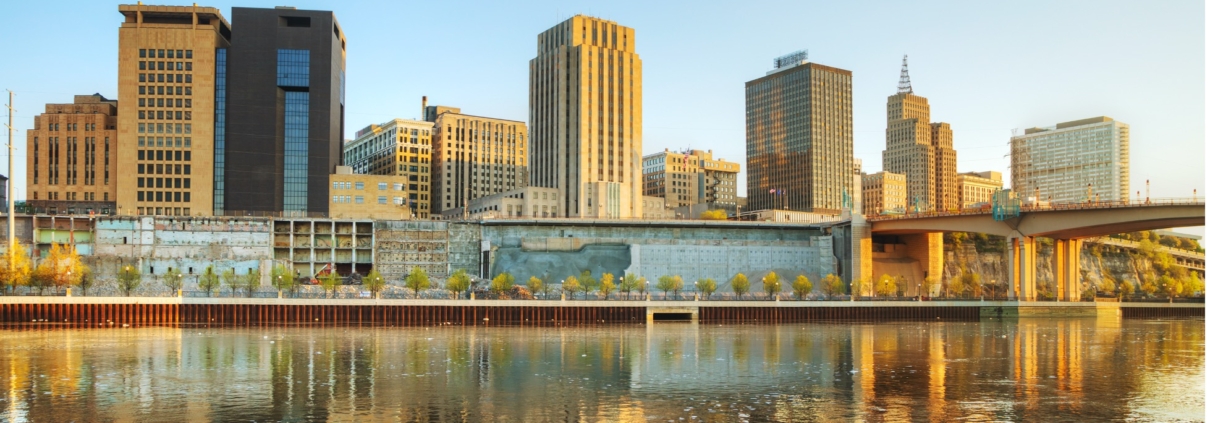
Why do birds fly into windows? Birds do not recognize glass windows, or highly glazed building walls, as obstacles. The birds see reflections of the sky or nearby trees and think it is safe to fly ahead. Instead, they hit the window or wall head-on at high speed.
What to do if a bird strikes your window?
Collect them into a paper bag or box and get them off the sidewalk or yard. Keep them away from dogs, cats, children. Do not try to feed or water them. Take them to the nearest Wildlife Rehabilitation Center as soon as possible. In the Twin Cities the WRC is at 2350 N. Dale, Roseville, MN 55113.
What more can be done to prevent bird strikes?
Join with your local neighborhood group, student group on campus, or conservation groups like Saint Paul Bird Alliance, Land of Lakes Bird Alliance, Friends of the Mississippi River. We all need to stand up together for more bird safe measures in our community.
We are blessed to live in the area of the Mississippi River Flyway where over 325 species migrate North in the Spring and South in the Fall. Other flyways in North America are the East Coast Flyway on the Atlantic Ocean, the Central Flyway along the Rocky Mountains, and the West Coast on the Pacific Ocean. It is thought our Mississippi River Flyway hosts 40% of all the migrants.
Hosting these birds on their journey brings responsibilities to all of us. We need to preserve critical habitat up and down the River for migrating and resident birds. Just like people, birds need clean water, clean air, green space, secure resting places, safe transportation routes, and bird-safe buildings.
We are responsible to do what we can to make our buildings safe for birds. Minnesota law now requires bird-safe glass in all new construction using state bonding funds.
We need stronger legislation so that bird-safe glass and bird-safe buildings are required in all new construction in the Mississippi River Corridor Critical Area. And we need local and state legislation requiring bird-safe buildings throughout Minnesota whenever and wherever public funds and incentives where government bonds or tax increment financing are being used.
Many cities around North America already have bird-safe building codes. These include New York City, Washington DC, Madison WI, Berkeley CA, Mountain View CA, Portland ME, Portland OR, Middleton WI, San Francisco CA, Austin TX, and Evanston IL. Oakland CA, Chicago and Detroit are studying bird-safe building codes.
Won’t you help in making Minnesota a bird-safe state? Join us at an upcoming St Paul City Council public hearing (date to be determined) and at the October 15 Town Hall meeting on River Issues with Mayor Carter (6 pm Highland Park Community Center, 1978 Ford Pkwy, St Paul, MN 55116).

Avian Influenza in Minnesota – Presentation Recording Available
Co-Sponsored with Land of Lakes Bird Alliance
Avian Flu is in the news again. This talk will provide a brief overview of avian influenza in Minnesota and discuss the current state of the disease in the state. Ms. Baker will also discuss key actions you can take to prevent contributing to the spread of this deadly disease.
Liz Baker is a member of the Wildlife Health Program within the Minnesota DNR. She has been with the program since August 2022, and her position focuses on data management and disease response activities.

Pig’s Eye Update – Kiki Sonnen
Multiple agencies manage Pig’s Eye Park. The lake itself spans 600 acres. The wild land around the lake and to the north is also approximately 600 acres, making this one of the largest parks in Ramsey County. The parkland north of the lake is Pigs Eye Park, which is a property and jurisdiction of the City of St. Paul. The Ramsey County Parks Department owns the lake and surrounding lands and is part of the Battle Creek Regional Park.
Pig’s Eye Lake is a public water under DNR jurisdiction. The Minnesota Department of Natural Resources has designated Pig’s Eye Island #2 as a Scientific and Natural Area and Sanctuary for the colonial water bird rookery. Historically, the colony was the breeding and nesting site of Great Blue Herons, Great Egrets, Black-crowned Night Herons, and Double-crested Cormorants. Sometimes Yellow-crowned Night Herons, Snowy Egrets, and Little Blue Herons also nested there. Now, two pairs of Bald Eagles are nesting on the island.
About two years ago, the Pig’s Eye Heron colony collapsed, and the birds left. The Eagles stayed, and some of the Double-crested Cormorants stayed too. All the Black-crowned Night Herons are gone. However, 42 Great Blue Herons moved upstream and are nesting on Pig’s Eye Island # 1. I asked someone at the DNR if the SNA designation could travel to the herons’ new home. No, they said.
Why did the Rookery collapse? Did the Corps of Engineers’ Island building disturb the birds? Was there a spill or chemical leak into the water or contamination of the fish the birds are eating? Probably not, since we would have found bodies. We do know that Black-crowned Night Herons are experiencing a complete population crash across the state. The Great Blues are also seeing a steady decline statewide.
Endangered Blanchard Cricket Frogs are found at the south end of Pig’s Eye Park. This summer, Kathy Sidles spotted the endangered Rusty Patch Bumblebee in the northern part of the park—eight pairs of Bald Eagles nest in the Pig’s Eye area. Pelicans, Sandhill Cranes, and Trumpeter Swans are here during migration, as are warblers, shorebirds, and many songbirds. Grassland birds like Dickcissels, Meadowlarks, and certain Sparrows breed here. Year-round resident birds such as Crows, Cardinals, Chickadees, and Nuthatches also breed here. Beavers, Coyotes, white-tailed deer, mice, skunks, raccoons, voles, and shrews live at Pig’s Eye. Leopard Frogs, toads, and garter snakes are present. Many kinds of butterflies, moths, dragonflies, grasshoppers, katydids, and cicadas are here as well. Pig’s Eye Lake is a vital spawning ground for River Fish. The baby fry stay in the lake, which serves as their nursery until they are strong and big enough to live in the main channel of the Mississippi River. These fish include Bigmouth Bass, Smallmouth Bass, Walleye, Sauger, Catfish, White Bass, Bluegill, Crappie, panfish, Carp, and more.
Pig’s Eye Park Friends have been carefully monitoring the work of the Pig’s Eye Dump Commission. Established by the State Legislature several years ago, the Commission is tasked with recommending the cleanup of the dump beneath the Pig’s Eye area and restoring the land for the future. The Commission includes representatives from the MPCA, DNR, the State Department of Health, the Corps of Engineers, the Met Council, the Cities of St. Paul, South St. Paul, and Newport, as well as Ramsey and Dakota Counties. I believe they are considering four or five options. Pig’s Eye Park Friends prefer the most expensive option, which involves a complete cleanup of all hazardous materials and substances, removal to a licensed, regulated haz-mat dump, and restoration of the land to natural resource habitat, such as wet meadows, pothole habitats, and forested floodplains. While this option may be the costliest, it is the only way to fully clean up Pig’s Eye once and for all. We envision low-impact recreation, including birding, wildlife watching, and hiking. We hope the cleanup and restoration will be staged so that existing mature trees and natural landscapes can shelter wildlife in one area, while another area is cleaned up and restored.
At the Park entry is a park welcome sign to Pig’s Eye Park. Chôkan Tanka is Dakota for Big Middle. Pig’s Eye is situated between Prairie Island, the homeland of the Dahkota on the South, and the confluence of the Mississippi and Minnesota Rivers on the North. The confluence is the Dahkota’s storied origin place. Chôkan Tanka was the traditional summer home of the Dahkota. It was a place to fish, hunt, and gather. It was a place where travelers from other tribes could meet to exchange supplies, share stories, news, and ideas. The Big Middle binds all of us together.
These recent features are part of a Star Grant Councilmember Jane Prince and Pig’s Eye Park Friends secured for the park:
- Wayfinding signs showing how to get to Pig’s Eye are now in place on Warner Road and at the tricky intersection of Childs Road and Pig’s Eye Lake Road.
- The entryway has giant logs separating park traffic from Woodchipper traffic.
- The park parking lot is a nice feature. Since the signs and parking lot were installed, we’ve seen many new park visitors.
- Still to be done is the removal of the mountain of Water Department sewer sludge soil. The slowdown is that the soil has to go to a licensed dump that accepts contaminated soil.
- Eventually, the Park will have a bike rack, seasonal satellite restrooms, and a Kestrel nest box.
This week, 20-30 U of M Fall semester students studying landscape architecture will tour Pig’s Eye Park. We hope you, too, can make a trip to Pig’s Eye and experience this gem for yourself. Pig’s Eye Park Friends meet regularly at 9:30 a.m. Tuesdays in the parking lot and explore the trails for an hour or two. All are welcome.