
Watching the Skies: How Community Science is Rallying for the Endangered Chimney Swift
Watching the Skies: How Community Science is Rallying for the Endangered Chimney Swift
In 2026, members of the Saint Paul Bird Alliance stepped up to protect a vulnerable species by participating in the Chimney Swift Monitoring Project. This vital community science initiative was led by a powerful coalition, including the Urban Bird Collective, the Minnesota Department of Natural Resources, the U.S. Fish and Wildlife Service Migratory Birds program, and the Minnesota Valley National Wildlife Refuge. Together, volunteers gathered critical ecological data to help reverse the fortunes of the Chimney Swift (Chaetura pelagica), an aerial insectivore whose populations are in decline.
Because Chimney Swifts rely heavily on human-built chimneys for nesting and roosting, the Twin Cities and surrounding regions are a crucial battleground for their observation and protection. Local communities responded to this need in record numbers this year. Statewide volunteer participation surged by 400%, growing to a dedicated network of over 85 volunteers. From May 1st through August 30th, these community scientists kept a watchful eye on local skies by monitoring historical roosts biweekly, identifying entirely new roosting locations, and mapping their own discovery sites.
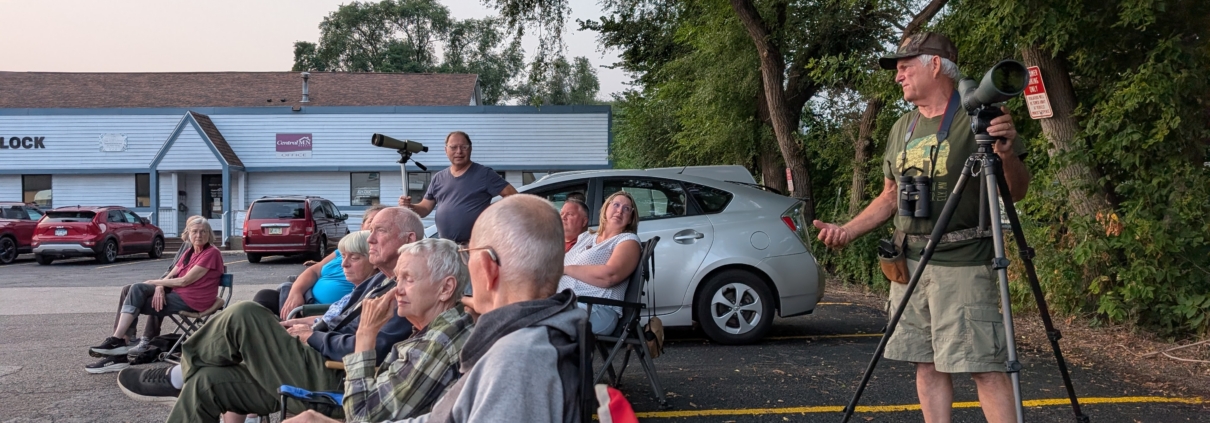
The project also brought neighbors together through nine community “swift sits,” where attendees gathered to watch swifts stage in large numbers before their long journey south. While enthusiasm was high, the data revealed some sobering trends. Monitors noted lower bird counts this season, which coordinators believe stems from a lack of food sources due to this year’s intense regional droughts and wildfires. Last year at our Mahtomedi sits, we had numbers from 2,000 to 3,000 on some nights; this year we had a high of 725.
The fight to protect these incredible aerial acrobats will continue next year, and we need your help. If you would like to join the effort as a monitor for the next season, please reach out to Monica Bryand at urbanbirdcollective@gmail.com to be added to the official project mailing list. Next year will start with project info, then training for all volunteers.
–Monica Bryand

Pigs Eye Regional Park Hike Tuesday 09/22/26, Kathy Sidles
WE LEARNED ABOUT DRAGONFLIES ON THE CONCRETE BRIDGE FROM JOHN ARTHUR – John has been learning and teaching about dragonflies for many years. They spend most of their life in the water as aquatic insects. Then, when adults, they fly around eating insects, sometimes without stopping to rest. They can use the sun for energy too. And a few species migrate…with Kestrels traveling with them, hoping for a meal. As aquatic insects, they breathe through their butt, he said. Some of us snickered like the school kids he tells this to. I will look this up someday! A Damselfly flew by. John said they are related but generally put their wings together over their back instead of spreading them out like Dragonflies.
HEADING DOWN THE TRAIL – A Kestrel was still on the Kestrel nest box – looks like a more colorful male. Sometimes it would fly down to catch a meal (small birds, dragonflies, snakes, rodents) and fly back to eat it. We saw a second Kestrel – a female in my picture – in a woodland tree above a wetland. We saw a few dragonflies until we got closer to where Battle Creek flows into Pig’s Eye Lake, and then we saw a LOT of them. They were glinting in the sun, flying a few feet over the grassland near the creek. A cloud covered the sun, and then we didn’t see them…the sun came back, and we still didn’t see them! Barb said she and Kiki saw them at the bridge, so maybe they were moving around as a group chasing insects. The Dragonflies were not stopping for pictures. But John was able to ID four or more species by how they flew. He showed us a picture of Saddlebags in his ID book – and could see the “saddlebags” next to their wings as they flew by us.
AT PIG’S EYE LAKE – One highlight of the walk was seeing more than 200 Pelicans flying over and landing on the lake, then flying up and away! This was more Pelicans than many had ever seen at one time.
ON THE WAY HOME – Most people took the short loop mowed trail back. We took a picture of a Damselfly resting on a stick on the trail. And one of the handful of species of Katydids looking like a leaf – a Broad-winged Katydid maybe. A couple of people took the longer trail loop back. It was the first time most of these birders had been in this park. Despite the wood chipping, RR and airplane noise, and difficulty finding the park, it was fun for them to see the rich wildlife. I bet some will be back to Saint Paul’s biggest park and former dump waiting for cleanup. Maybe for special Saint Paul Bird Alliance or other events, or for Pig’s Eye Park Friends 9:30 AM walks on most Tuesdays and Saturdays.
Kathy Sidles
American Kestrels -Another Successful Nest Box Season
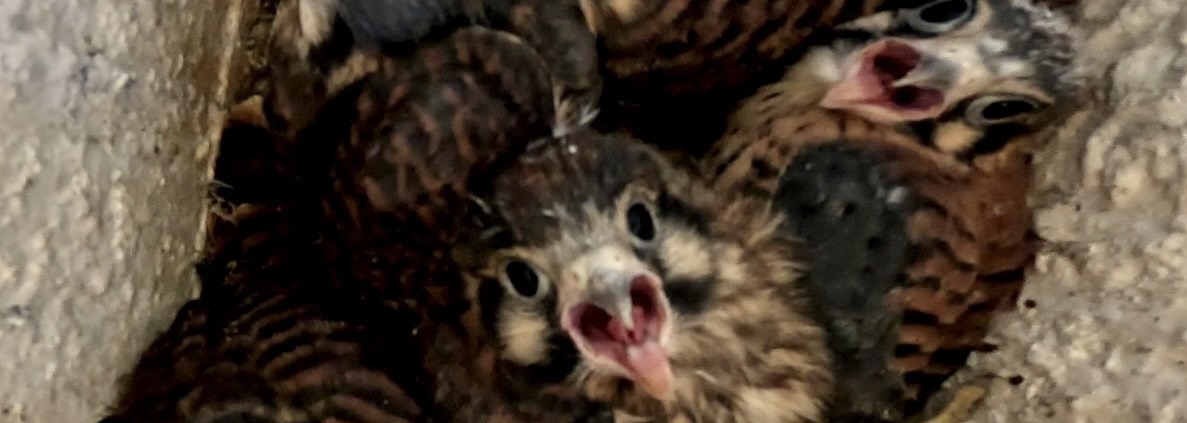
Saint Paul Bird Alliance volunteers have led a project since 2012 to supply nest boxes for American Kestrels in the East Metro area. Since 2012, dedicated team members have monitored and reported the nesting outcomes for these boxes. Approximately 185 Kestrels have fledged since the project’s inception.
2026 was another successful year for local Kestrels and for the nest box team. Four of seven nest boxes successfully produced offspring. From each of these four boxes, five young Kestrels fledged successfully. As usual, we reported this information to the citizen science effort called NestWatch.
This season, we installed a new nest box at Pigs Eye Park, though it hasn’t been used yet. We’re discussing repositioning the two Lake Elmo nest box locations to better attract Kestrels.
Also, the Kestrel team no longer maintains and monitors the nest boxes installed at Rice Creek North and Tamarack Nature Center because Ramsey County has assumed this responsibility.
According to Cornell Lab of Ornithology’s All About Birds, American Kestrels are North America’s smallest falcons and are some of the most colorful of all raptors. They perch on wires or poles, or hover while facing into the wind, as they hunt for insects or other small prey in open territory.
Debbie Brown – VP and Co-Chair – Conservations Committee