
• Link to Facebook
  • Link to X
  • Link to Youtube
Saint Paul Bird Alliance
  • About
    • Who We Are
    • Chapter Leadership
    • Annual Reports
      • 2024-2025 Annual Report
      • 2023-2024 Annual Report
      • 2022-2023 Annual Report
      • 2021-2022 Annual Report
      • 2020-2021 Annual Report
      • 2019-2020 Annual Report
    • Finances
      • 2022-23 Financial Summary
      • 2023-2024 Financial Summary
      • 2025 – 2026 Budget
    • Board Minutes
      • Board Minutes 2024
        • Jan. 2024 Board Minutes
        • Feb. 2024 Board Minutes
        • March 2024 Board Minutes
        • April 2024 Board Minutes
        • May 2024 Board Minutes
        • Sept. 2024 Board Minutes
        • Oct. 2024 Board Minutes
        • Nov. 2024 – Board Minutes
        • Dec. 2024 Board Minutes
      • Board Minutes 2025
        • Jan. 2025 Board Minutes
        • Feb. 2025 Board Minutes
        • March 2025 Board Minutes
        • April 2025 Board Minutes
        • May 2025 Board Minutes
        • May 2025 Annual Meeting and Election Board Minutes
        • Sept. 2025 Board Minutes
        • Oct. 2025 Board Minutes
        • Nov. 2025 Board Minutes
        • Dec. 2025 Board Minutes
      • Board Minutes 2026
        • Jan. 2026 Board Minutes
        • Feb. 2026 Board Minutes
        • March 2026 Board Minutes
        • April 2026 Board Minutes
  • Events
  • Get Involved
    • Volunteer
    • St. Paul Bird Alliance Membership
    • Join National Audubon
  • Grants
    • Applying For A Grant
    • Grants in Action
  • Conservation Action
    • American Kestrel Nest Box Monitoring
    • Battle Creek Properties at Risk
  • News
    • News Blog
    • Archive: Newsletter
    • Subscribe
  • Contact Us
  • Click to open the search input field Click to open the search input field Search
  • Menu Menu

Eavesdropping Helps Birds Avoid Danger
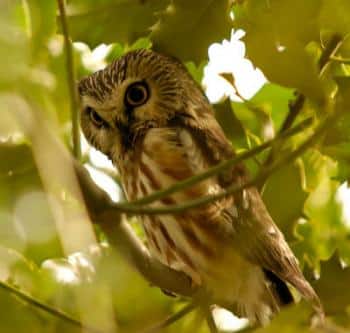
A tiny saw-whet owl lurking in the woods

A tiny saw-whet owl lurking in the woods gives small birds the heebie-jeebies. The owl’s call sounds like a saw being sharpened
Photo credit: Brendan Lally

 
by Val Cunningham
Contributing Writer

When chickadees chatter that a predator is near, other birds do well to listen.

Sometimes it takes a while to really know what we’ve seen.

Recently, some birding friends and I were drawn toward a tree where a number of small birds were making a commotion. Five or six chickadees and several nuthatches were calling “dee-dee-dee” or “yank-yank” as they flew around a leaf clump in a tree fork. We knew that the little birds sensed danger.

So we weren’t surprised when a careful scan revealed a tiny owl, the saw-whet owl, hiding among the leaves. The smaller birds were harassing the intruder in a behavior called mobbing, trying to drive it away because they recognized the owl as a predator who might snatch a chickadee or nuthatch.

Fast forward a few weeks, as the same bunch of birders strolled through a suburban park featuring tall red pines. Suddenly a feeding flock of chickadees and nuthatches circled the top of one tree, uttered a few loud “dees” and “yanks,” but then quickly moved on. Since they hadn’t seemed very alarmed we didn’t look very hard for a predator. Luckily for us, the morning sun spotlighted a large great horned owl hidden among the branches at the top of a pine or we might have missed it.

Discussing this later, we thought it odd that the small birds seemed much more agitated by the small owl (a bird only 8 inches tall). They circled its hiding place over and over while making alarm calls. The chickadees and nuthatches seemed less concerned about the massive great-horned owl, which got only a cursory shout-out from its little mobsters.

Reading up on bird mobbing later, the truth behind what we were seeing was revealed. Traveling around on their morning feeding route, the small birds had suddenly noticed the saw-whet owl hiding in their territory. If they’d been humans, we’d have said they freaked out, knowing that the small, agile owl was capable of catching and eating songbirds (although mice and voles make up most of its diet). Hence, their strident reaction to the small predator.

In contrast to our other owl sighting, chickadees and nuthatches had been searching for food when they paused briefly. They’d suddenly spied the huge owl with its enormous yellow eyes and 55-inch wingspan. But they hardly reacted, since they were aware that he hunts larger prey, such as rodents and rabbits, and doesn’t pose a threat to birds their size: less threat produces less fuss.

Researchers who study birds know that chickadees use a code when they’re alarmed. The more “dees” they call out at a time, the greater the danger. They’d sounded about 10 “dees” for the tiny saw-whet owl, but only about two for the great horned owl. A recent study indicates that other species can “speak” the chickadee language.

A researcher at the University of Washington (Christopher Templeton) set a recorder in the woods and played tapes of chickadees calling out five, 10 or 15 “dee” sounds. The recordings drew in nuthatches, similar in size to chickadees and vulnerable to the same predators. The more “dees” they heard, the greater the number of nuthatches that flew in to drive an intruder away.

This surprised Templeton: “Knowing what kinds of predators are around can be a matter of life or death for birds, so it pays to listen to the alarm calls of other species.” He and others were amazed to discover this evidence that one species had cracked the code of another species and extracted vital information.

Each day is a race for survival for small birds, and they need to work hard to beat the odds. Learning what other birds are communicating can be a real advantage when danger lurks nearby.

St. Paul, Minnesota resident Val Cunningham, leads bird hikes for the St. Paul Audubon Society and writes about nature for local, regional and national newspapers and magazines.

Bird Spotlight

  • Red-Bellied WoodpeckerJanuary 29, 2014 - 5:42 pm
  • 8 Ways to Help BirdsDecember 29, 2013 - 5:20 pm
  • The Squeaky Bird of the ForestNovember 16, 2013 - 7:20 pm
  • Bird World Changes With the SeasonsOctober 16, 2013 - 7:48 pm
  • A River of Birds Stream by at NightSeptember 16, 2013 - 8:19 pm
  • Male Rose-breasted Grosbeak
    Grosbeaks are the Bandana BirdJuly 19, 2013 - 7:26 pm
  • Indigo Bunting
    Blue Indigos Catch the Eye — and EarJuly 19, 2013 - 7:12 pm
  • Very young red-tailed hawks
    Nest Cams Put You in the Catbird SeatJune 19, 2013 - 7:40 pm
  • Great-horned Owl
    It’s Hooting Season for Great-Horned OwlsFebruary 19, 2013 - 7:48 pm
  • male Pine Grosbeak
    Watch for Handsome, Hungry Winter FinchesJanuary 19, 2013 - 8:02 pm
  • White-breasted Nuthatch
    Birds Triumph Over the ColdDecember 20, 2012 - 6:47 pm
  • Downy Woodpecker at suet feeder
    Downies, the Pocket-Sized WoodpeckersNovember 20, 2012 - 6:54 pm
  • Scarlet Tanager
    Birds Eating WeirdlyOctober 20, 2012 - 7:22 pm
  • Sandhill Crane
    Cranes families are on the moveSeptember 20, 2012 - 7:35 pm
  • Pair of prothonotary warblers
    Songs subside as birds rear their youngJuly 20, 2012 - 7:45 pm
  • Blue Jays hash it out at feeder
    Blue Jays Get a Bad RapJune 21, 2012 - 3:25 pm
  • Tree Swallow nest
    The Incredible EggJune 21, 2012 - 3:21 pm
  • Male goldfinch feeds young
    Nature’s TurncoatsMay 21, 2012 - 3:32 pm
  • great horned owl
    Night’s silent hunters may live in your ‘hoodApril 21, 2012 - 4:07 pm
  • White-throated Sparrow
    Beautiful Springtime MusicApril 21, 2012 - 3:45 pm

Saint Paul Bird Alliance
P.O. Box 7275
St. Paul, MN 55107

Saint Paul Bird Alliance is a chapter of the National Audubon Society, Inc.

Donate to Saint Paul Bird Alliance >

Subscribe to The Cardinal newsletter >

Upcoming Events >

Contact Saint Paul Bird Alliance >

© Copyright - Saint Paul Bird Alliance 1945 - 2024. All Rights Reserved. | Powered by simpleDesigns
  • Link to Facebook
  • Link to X
  • Link to Youtube
Link to: February/March 2010 Link to: February/March 2010 February/March 2010 Link to: Urban Eagles Link to: Urban Eagles bald eagleUrban Eagles
Scroll to top Scroll to top Scroll to top