
Nest Cams Put You in the Catbird Seat
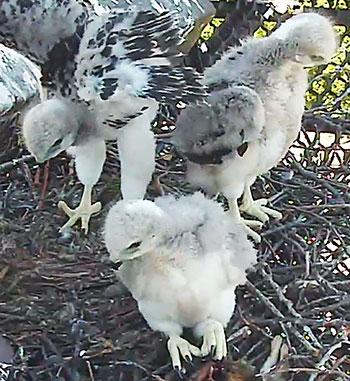
Very young red-tailed hawks survey their world from a nest high atop a light pole in Ithaca NY
Photo: Cornell Lab of Ornithology
by Val Cunningham
Contributing Writer
One of the most endearing thing about birds is how much of their lives are lived on view, out in the open. We watch them drinking and bathing, foraging for food and eating it, resting on perches and even copulating. We can observe nearly every aspect of avian life—except for the most important of all, their lives as parents. That’s almost always been hidden, tucked away inside a cup nest back in a shrub or within a tree cavity.
Until now.
Now we’re right there, shoulder to shoulder with parent birds, figuratively perched on the rim of the nest. We watched a female red-tailed hawk lay her eggs last year in a stick nest atop an athletic field light pole in Ithaca, N.Y., and then share nest duties with her mate. We’re entranced by a fluffy puffin chick in an underground burrow on an island off the Maine coast, attacking a fish brought in by its parent.
We were on pins and needles as a pair of majestic bald eagles incubated three eggs during Minnesota’s weeks of late winter cold. And thousands laughed out loud at the antics a year ago of five gawky great blue heron chicks as they explored their stick nest in Ithaca and jockeyed for front row when a parent flew in with food.
Bird’s eye view
Welcome to the era of “nest cams,” providing live and intimate looks into birds at their nests, using the latest in broadband Internet and video streaming. There are thousands of cameras around the world pointed at bird nests, sharing live images with their avid audiences. Anyone with a computer can tune in at any time of day to view the nest activity, all the way from egg laying to fledglings departing.
Fans of web cams find this access to be almost magical, and are fascinated by each new wrinkle as chicks hatch and grow. There are those of us who even become emotionally invested in the infant birds, and spend hours conversing in chat rooms that accompany some camera operations.
Eagle watchers in 100 countries around the world visited the Minnesota Department of Natural Resources’s eagle cam site earlier this year, logging more than a half million visits to view a pair of bald eagles fighting snow and cold to incubate their very early eggs.
“This gave people a taste of the lives of wildlife without leaving their homes,” says Lori Naumann, who headed up the eagle cam project for the DNR’s Nongame Wildlife Program. She noted that such cameras require a great deal of weather protection in climates like ours.
As millions watched
Last year’s red-tailed hawk and great blue heron nest cams set up by the Cornell Lab of Ornithology each recorded more than 2 million viewers, a phenomenal number. Each set-up featured video and sound, so viewers could both see and hear all the action. The Lab’s chat rooms reverberated with viewer’s concerns (“Isn’t it too cold for the babies?”; “What if a chick falls out of the nest?”; “Are they getting enough food?”), patiently answered by staff and volunteers.
“Our nest cams offer an intimate perspective into the everyday lives of birds, providing something both ordinary and extraordinary,” says Charles Eldermire, who heads up the Cornell Lab project. “This is a very empowering and engaging tool to connect people with birds and the natural world.”
A down side?
Is all this voyeurism a good thing? Nest cams are set up so they don’t hinder the birds at the nest. They attract a broad spectrum of people, many of who may not have been much interested in birds before tuning in. Another plus: both the Nongame Wildlife Program and Cornell Lab enjoyed increased traffic to their organizations’ other web pages by those who started out on the web cam sites.
The only possible downside is that nature is unpredictable and can appear cruel to the uninitiated. The eagles’ eggs failed to hatch, after weeks of incubation, all on view on the DNR site, and cameras elsewhere have recorded the death of chicks or destruction of nests by predators. Most nest cam operators will not intervene, letting nature take its course.
Overall, says Cornell’s Eldermire, the cameras are having an “overwhelmingly positive impact on raising awareness about birds.”
And, as the DNR’s Naumann says, “The cameras bring nature up close and personal to people, and we hope this inspires them to go outside and see for themselves.”
Nests cams
Here are links to a number of nest cams:
https://www.dnr.state.mn.us/features/webcams/
http://cams.allaboutbirds.org/
http://www.internationalowlcenter.org (click on Rusty and Iris link)
http://birdcam.xcelenergy.com/
There are many others around the country and around the world—just do an Internet search for “nest cams” to find more.
St. Paul, Minn., resident Val Cunningham, who leads bird hikes for the St. Paul Audubon Society and writes about nature for local, regional and national newspapers and magazines.