
Cranes families are on the move
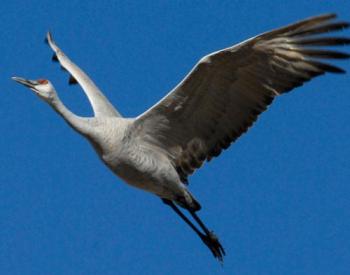
Sandhill Crane
Photo credit: Jim Williams
by Val Cunningham
Contributing Writer
Standing in a large wooden viewing box in the pitch dark on early April morning, a group of us waited for thousands of sandhill cranes to awaken.
And when they did, the world became a dazzling spectacle of sight and sound, as thousands of cranes talked among themselves and then launched their big bodies into the sky. By mid-morning, when we left the blind, we’d seen something like 10,000 cranes heading out for a day of feeding in nearby fields.
Yes, the annual springtime gathering of sandhill cranes along the Platte River in Nebraska is one of the most imposing sights in the world of birds. Something like 500,000 sandhills—80 percent of their world population—drop down along this shallow Western river to rest and feed before continuing on their migratory journeys.
But you can enjoy a view of these tall, stately birds much closer to home during the next month or so. Sandhills are beginning their autumn migration and they’re stopping off in Minnesota’s wide open spaces to feed on waste grains in fields during the day and sleep, standing up, in open marshes and shallow waters at night (see some locations below).
Singing and dancing
Cranes are among the largest of birds, measuring four feet tall or more on long, skinny legs, and weighing in at 10 to 15 lbs. If you could stand next to a sandhill, you’d get a good feel for how imposing they are, with the top of the bird’s coming up to your collarbone. But migratory cranes give humans a wide berth, as well they might: They’re very wary, after being almost wiped out by over-hunting in the last couple centuries.
There are many things to like about sandhill cranes, and one of their best-known features is their amazing dancing. This behavior is jaw-droppingly spectacular, as one crane suddenly begins flapping its wings, then jumping into the air before bowing and bouncing beside another. Soon an entire group may begin dancing, adding some grass-tossing and sideways hopping to their routines. Dancing is part of their courtship ritual, but they also dance year-round and throughout their lives, possibly for the sheer joy of it, no one knows.
Something else unique to cranes is their bugling call, loud enough to be heard from a mile away. An extraordinarily long trachea coiled inside their chests enhances the cranes’ trumpeting calls (hear this sound here). Every birdwatcher I know snaps to attention when they hear this sound, since it’s not all that often we’re in the right place at the right time to find cranes.
Good parenting
The most endearing aspect of crane behavior to we humans is their devotion to their families. Cranes mate for life and a pair may spend 10 to 15 years together. They get high marks for parenting skills while raising their chicks in swamps and wetlands. And cranes are one of the few bird species that migrates in autumn with their offspring to winter homes. This gives young cranes a huge advantage, because migration is a very hazardous business, lethal to a high percentage of other kinds of birds.
You can watch sandhills in Minnesota and Wisconsin until the end of October as they prepare to fly to Gulf Coast states. One excellent viewing area is around Sherburne National Wildlife Refuge. Betsy Beneke, visitor services manager at the refuge, says, “In the fall we can have thousands of cranes in the area, coming in to roost at sunset in our refuge pools, then flying out at sunrise to forage—this can be quite a sight.”
Sherburne is holding a crane tour on Saturday October 6 from 6:30 a.m. to 8:30 a.m. (see below for details). Yes, you will need to set the alarm clock for a very early hour, but it will be worth it. And if you can’t make it on that day, visit the refuge’s web site to download a crane viewing map.
Seeing sandhills
Where can you see sandhill cranes? Try Sherburne National Wildlife Refuge near Zimmerman, Minn. In addition, sandhills stop over in large numbers at Crex Meadows Wildlife Area near Grantsburg, Wis. And they often may be spotted around Carlos Avery Wildlife Management Area near Forest Lake before they depart in late October.
St. Paul, Minnesota resident Val Cunningham, leads bird hikes for the St. Paul Audubon Society and writes about nature for local, regional and national newspapers and magazines.