
Night’s silent hunters may live in your ‘hood
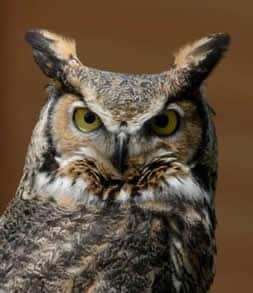
If you’re a rodent, you don’t want those big eyes turned in your direction.
Photo credit: Jim Williams
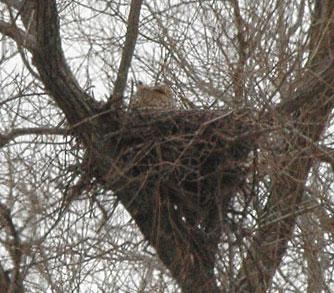
A female great horned owl on her nest. Females are larger than males, weighing almost 4 pounds
Photo credit: Jim Williams
by Val Cunningham
Contributing Writer
Great horned owls begin nesting in late winter, with some even wearing ‘snow hats” as they sit on their eggs.
A barrel shape, a big round head and a heavy mass of sticks: these are the only details you had time to absorb as you drove by a field with a big oak tree.
That shape is a great horned owl, and the mass of sticks is its nest for the year. A pair of red-tailed hawks built the nest and raised their young in it last summer. This year it belongs to a pair of the big owls, who’ve had their big yellow eyes on it since early in the winter. (One quick aside: those feather tufts on top of the owl’s head are neither horns nor ears. These protrusions help the owls look like a tree snag and possibly escape notice as they doze during the day.)
Because great horned owls aren’t builders they’re eager to find an abandoned nest built the year before by a hawk, bald eagle, crow or even great blue heron. The most powerful owl in North America, these are the first owls to engage in courtship and breeding each year, starting the process in late winter with hoots and calls in the night. A female lays her eggs in late February or early March in our region, then starts the month-long process of egg-sitting, even as late winter rages around her.
Snow hat
In fact, it’s not unusual to see a female great horned owl wearing a snow hat as she hunkers down during a storm. She can’t leave the nest for more than a few minutes at a time, to keep her eggs from freezing. Even after her two or three chicks hatch, she will keep brooding them for several weeks until they’re feathered enough to stay warm.
Why do great horned owls nest so early, people wonder? The answer has to do with how long it takes their offspring to become mature enough to survive on their own, which translates to developing adequate hunting skills. And since they hunt at night—in fact, the night could be said to belong to great horned owls—there’s more to learning to locate and catch prey than there is for other raptors like hawks, who hunt by sight in daylight.
Owls have extraordinarily well-developed senses and young owls must learn to use the information gathered by their keen eyes and ears to become successful hunters. Owl ears can hear the tiniest squeak from a mouse hundreds of feet away, and their huge eyes can see in very low light. But it takes dozens of misses before they successfully pounce on their first mouse or vole with those sharp talons.
Gross out
Kids tend to like gross things, so they’re fascinated by one of the products of an owl’s unique digestive system, the dark, cigar-shaped pellets often found under an owl’s roost tree. Owls generally swallow their prey whole, and lack the stomach juices to break down fur and bone. So after the protein portion of their prey moves to the small intestines, the indigestible stuff gets packed together and coughed up as a furry pellet hours after eating. Researchers (and school classes) pick apart owl pellets to get an idea for what the raptors have been eating. The great horned owl’s diet, while broad, is primarily made up of small mammals.
However, they are fierce, powerful hunters and will kill and eat other big birds like hawks, herons and other owls, as well as mice, voles, rabbits, porcupines and even skunks. Although most predators avoid skunks, great horned owls seem to relish them; in some cases parent birds bring back so many skunks for their offspring that their nest can be located by smell. Sometimes called “tigers of the night,” due to their ferocity, great horned owls help keep rodent populations in check.
Duluth ornithologist and naturalist Laura Erickson, in her recently published Twelve Owls, notes that we live in close proximity to owls, even in cities and suburbs. Most Minnesotans, she says, live less than five miles from an owl.
And since great horned owls are our most plentiful owl species, chances are that this owl doesn’t live far from you.
St. Paul, Minnesota resident Val Cunningham, leads bird hikes for the St. Paul Audubon Society and writes about nature for local, regional and national newspapers and magazines.