
Red-Bellied Woodpecker
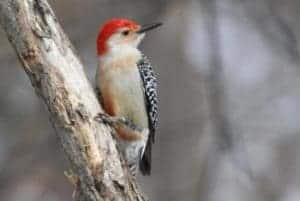
A handsome red-bellied woodpecker probes beneath tree bark for insects.
Photo by Don Severson
by Val Cunningham
Contributing Writer
Woodpeckers and their cohorts wrangle through the winter woods in search of high-energy food to fuel their active lifestyles.
A small stand of trees in Como Park in St. Paul hosted a surprising number of birds one recent winter morning. Downies and hairys, those familiar black and white woodpeckers, were tapping on tree bark, and two white-breasted nuthatches were calling “yank, yank” to stay in touch.
A red-bellied woodpecker, with its dramatic black-and-white barred back and brilliant orange-red head, busily probed the bark of a big oak. These large birds emit zany calls, one a sort of rolling “chirr” and shorter, resounding “cha, cha” notes. (Once you learn these sounds, you’ll always know when a red-bellied is around—they’re seldom silent as they forage. Listen to recordings here.)
And then I heard a faint, high-pitched call, repeated frequently. Was it a golden-crowned kinglet or a brown creeper? I sometimes confuse the two. But when a small bird skittered into view from the back of the tree trunk, it’s speckled brown back and curved bill announced it as a creeper. I love this bird’s wavering call, but it’s very hard to describe—some say it sounds like a thin metal chain dropping onto a table.
(Something serendipitous occurred as I left the woodlot and walked along a roadway: A driver began slowing for a stop sign and his Mercury SUV, maybe in need of a brake job, sounded exactly like a brown creeper calling.)
Dull name, bright birds
These woodpeckers, nuthatches and the creeper all are lumped into a category called tree-clinging birds, a drab name for such varied and vibrant species. They spend winter days searching for insects and caterpillars hidden away in the tree bark. As they hop or skitter upward, some of us wonder, “How do they do that?” And the answer is that such movements depend on their ingeniously adapted tails.
As a woodpecker makes its way up a trunk there’s a lot going on that we don’t perceive. Tree-clingers aren’t simply walking upward, instead they’re moving in a hitching, almost bouncing fashion. Within each “hitch” there’s a moment when the woodpecker’s feet leave the tree entirely for a split second. They’re able to do this because their stiff tail feathers act as a kind of spike, holding them to the tree as their toes spring upward. So up they go, feet reaching and tails anchoring to give them traction for the next hop.
These birds go about their business in a very determined fashion, so much so that I sometimes wonder how there can be any insects and spiders left to hatch or awake in the spring. Creepers work a tree from bottom to top, spiraling around the trunk or a branch as they probe bark crevices for carnivorous meals. The nuthatches work in the opposite direction, scooting around tree trunks from high to low in search of tidbits. The two species sometimes pass each other on their appointed rounds.
Beetle fans
Hairy and downy woodpeckers are very fond of wood-boring beetles and their larvae, and can be important predators of harmful insects in forests and orchards. Hairys are known to show up in numbers after a forest fire, since wood-boring beetle populations explode after such events.
The much-smaller downy woodpecker, with its tiny beak, can sometimes be found working a goldenrod field in winter in search of the fly larvae hidden inside round galls on plant stems. They’re the perfect size to perch on a stalk and hammer into the gall for the treat inside. (Next time you’re outdoors near a goldenrod field, check some galls to see how many have small holes bored in them.)
All of these birds can be attracted to your backyard feeders, even the shy brown creeper (I’ve never seen one on a feeder, but I’ve watched them at Springbrook Nature Center in Fridley as they feed on suet bits other birds drop to the ground). In my backyard, the woodpeckers and nuthatches relish shelled peanuts in metal tube feeders and come in many times a day to hammer at the suet cakes.
These birds make up a “suite,” a group of birds working in different ways on the same resource, and it can be sweet, indeed, to observe them going about their lives, whether in forests or at feeders.
St. Paul, Minn., resident Val Cunningham, who leads bird hikes for the St. Paul Audubon Society and writes about nature for local, regional and national newspapers and magazines.