
Songs subside as birds rear their young
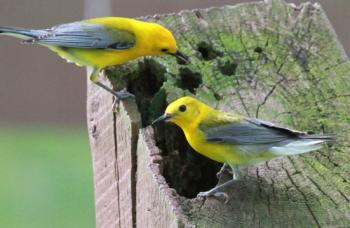
A pair of prothonotary warblers works tirelessly in June to keep their growing brood fed.
Photo credit: Don Severson
by Val Cunningham
Contributing Writer
Beaks stuffed full of insects to feed their young, most birds have retired their exuberant songs.
It’s quieter in the morning these days, meaning that many of us are no longer being jolted awake by the exuberant birdsong that burst forth in early summer just before dawn. Male birds who were singing in May and June to carve out territories and appeal to females have gone largely quiet as they hustle to meet the demands of nesting season.
Most birds nest only once each year, putting all their eggs in one basket, so to speak. Birds like chickadees, orioles and blue jays spend mid-summer dashing around, feeding and guarding their fledglings.
They may not be singing courtship songs, but they still can be vocal. Indeed, there’s no bird louder than a parent blue jay when it senses danger is nearby. The decibels rise to ear-splitting levels as jays shriek and swoop at cats, foxes or hawks. Many other birds also can be very vociferous about lurking predators, spitting out short calls that signal danger.
Twice the work
However, some birds raise two broods (some even three), and these are the ones singing merrily away in the middle of summer. Double-nesters include house wrens, still chortling their liquid notes, cardinals chanting “cheer, cheer, cheer,” and blue birds issuing their whispery burble. The minute their first nest is empty, these birds engage in a quick courtship period, then build and fill a new nest with eggs to start brood number two.
A familiar “double nester” is the American robin, that big thrush that takes no time off during breeding season. As soon as the first spotty-breasted brood jumps out into the world, the female begins refurbishing her old nest or starting a new one. Soon four blue eggs cover the nest floor, and while Mom handles incubation duties, Dad feeds the first brood, dashing between begging juveniles, offering insects and worms. (It’s no wonder that robins look so ragged by the end of the summer.)
Several weeks out of the nest, young male robins begin spending a great deal of time practicing the robin song, sometimes beginning as early as 4 a.m. They have a template for their species’s song in their heads, but their practice screeches and shouts are initially a far cry from their father’s lovely warble.
Woodland sounds
During mid-summer’s heat, you may notice a loud and persistent song as you pass by a woodland or shrubby field. These singers are indigo buntings, bright blue males issuing their double-notes songs (hear buntings). Many buntings nest twice during the season, which helps explain why the woods ring with their sounds. Another dedicated songster is the warbling vireo, a seldom-seen bird that has one of the longest songs in the bird kingdom. They’ll run through their 15-note repertoire many times a day, hidden in a tree along a lake or stream (hear their song).
Sometimes the only way you know a bird is lurking in the foliage is by the blurt of a short, quick call, often just a piece of a species’s song. Many of the birds that nest in woodlands, such as great-crested flycatchers, blue-gray gnatcatchers and rose-breasted grosbeaks, now are largely silent except for an occasional call. Baltimore orioles, easy to spot as they fill the spring with their mellifluous songs, are now revealed only when they whistle a note or two as they glean through foliage for insects. Orioles sometimes make another sound, a low-pitched chatter, when stressed or alarmed.
All in all, after the summer solstice, mornings are quieter and birds are busier. We won’t hear most species’ vibrant songs until next spring’s breeding season. But birds are great communicators—that’s part of their charm for us humans. Territorial and mating issues may now be moot, but they still alert each other to danger, advise a mate or offspring that they’re coming in with a meal and express extreme displeasure at the sight of a hawk or owl.
St. Paul, Minnesota resident Val Cunningham, leads bird hikes for the St. Paul Audubon Society and writes about nature for local, regional and national newspapers and magazines.