
Blue Jays Get a Bad Rap
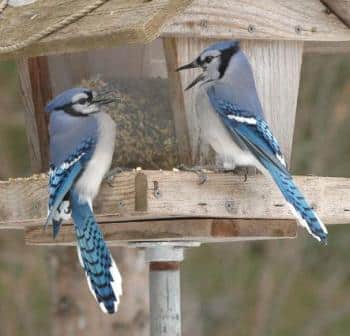
Blue Jays hash it out at feeder
Photo credit: Jim Williams
by Val Cunningham
Contributing Writer
These handsome birds are worth a second look as they barrel through each day without any need for assertiveness training.
They dash overhead by twos or threes, screeching and squawking, proudly flashing their bright wings, showing who owns the neighborhood. Yes, they’re a brash and noisy bunch, but they’re also remarkably beautiful, if you take the time to really study the blue jays who visit your backyard.
It’s my personal opinion that most of us are turned off by blue jays’ assertiveness and don’t give these smart, gorgeous birds the credit they deserve. Visitors from the U.K. and Europe gasp when they first see a blue jay, astonished by the bird’s aesthetics.
Think how amazing is it to have a large, blue bird streaking across the backyard. If you take a minute to concentrate on a jay, you’ll begin to notice how the soft blue on their upper back segues into lavender. An almost fluorescent blue in the wing feathers tops the thick white stripe on the wings. Add in that handsome crest and the black necklace above the pale chest and the sum total is a beautiful bird.
Not shrinking violets
Blue jays aren’t looking to pass unnoticed through life, quite the opposite. One of their most salient features is their loudness in all seasons of the year, screeching from treetops, shouting a challenge as they land on bird feeders and jeering at predators such as cats and owls wherever they may find them.
Jays are excellent mimics and can fool just about everybody and everything with their hawk calls. “Red-shouldered hawk,” a member of my birding group may call out, after hearing a whistle in the woods. And then we have to ask ourselves: was it a hawk or was it a blue jay? Same with broad-winged hawks, red-tailed hawks and even Cooper’s hawks, jays are adept at making these sounds and sometimes employ them to spook other birds.
Crying wolf
When they want to approach a bird feeder, they’ll sometimes give a hawk call or make their own loud, jay signal that a predator is near. As other songbirds dive for cover, smug blue jays land on feeders to gorge themselves in peace. This is how they got their reputation as the neighborhood bullies.
Jays have a large vocabulary and yet, for such well-studied birds, we don’t know much about what they’re saying. Their harsh jeer calls may be used to call other jays in, and their clear, liquid “pump handle” calls might be a “let’s come together” sound.
As counter-intuitive as it may seem, blue jays aren’t really blue—they just look that way. There’s no blue pigment in nature, so blue jays and bluebirds achieve their color by the way their feathers are structured, scattering most light and reflecting the blue wavelength.
Nutty birds
They’re so fond of acorns you might call them the squirrels of the bird world. Each fall individual blue jays collect and carry off thousands of acorns and bury them, one by one, in shallow holes and under leaves. (In one study, researchers fitted blue jays with radio transmitters and found that each bird cached between 3,000 and 5,000 acorns in the autumn.) Jays don’t remember where every nut is cached, with the result that many forgotten acorns sprout into oak trees. Researchers speculate that oak trees spread across the continent so rapidly after the last glacial period that they must have had help, and the credit is usually given to these active, nut-burying birds.
Many of us believe that blue jays relentlessly snatch and eat songbird nestlings each spring. This, however, appears to be more myth than truth: researchers analyzed the contents of hundreds of jay stomachs turned up bird traces in less than .01 percent of the time. Their diet emphasizes nuts, insects, soft fruits, seeds and small vertebrates.
So this spring, before they go all quiet and secretive as they raise their brood, let’s notice blue jays, rejoicing in the sheer beauty and cacophony of one of our regular backyard visitors.
Calcium deficiency
Like all female songbirds, blue jays need extra calcium during breeding season. In the East blue jays have picked up the trick of pecking and eating chips of light-colored paint from houses and other structures. The jays seem to have caught on to the fact that paint contains calcium carbonate or limestone as an extender.
To make it easier on these and other female songbirds, offer crushed eggshells in the spring, in or near bird feeders. First boil the shells for 10 minutes or heat in a 250-degree oven for 20 minutes, to kill off any pathogens. Then crush shells into small pieces and put outdoors.
St. Paul, Minnesota resident Val Cunningham, leads bird hikes for the St. Paul Audubon Society and writes about nature for local, regional and national newspapers and magazines.