
• Link to Facebook
  • Link to X
  • Link to Youtube
Saint Paul Bird Alliance
  • About
    • Who We Are
    • Chapter Leadership
    • Annual Reports
      • 2024-2025 Annual Report
      • 2023-2024 Annual Report
      • 2022-2023 Annual Report
      • 2021-2022 Annual Report
      • 2020-2021 Annual Report
      • 2019-2020 Annual Report
    • Finances
      • 2022-23 Financial Summary
      • 2023-2024 Financial Summary
      • 2025 – 2026 Budget
    • Board Minutes
      • Board Minutes 2024
        • Jan. 2024 Board Minutes
        • Feb. 2024 Board Minutes
        • March 2024 Board Minutes
        • April 2024 Board Minutes
        • May 2024 Board Minutes
        • Sept. 2024 Board Minutes
        • Oct. 2024 Board Minutes
        • Nov. 2024 – Board Minutes
        • Dec. 2024 Board Minutes
      • Board Minutes 2025
        • Jan. 2025 Board Minutes
        • Feb. 2025 Board Minutes
        • March 2025 Board Minutes
        • April 2025 Board Minutes
        • May 2025 Board Minutes
        • May 2025 Annual Meeting and Election Board Minutes
        • Sept. 2025 Board Minutes
        • Oct. 2025 Board Minutes
        • Nov. 2025 Board Minutes
        • Dec. 2025 Board Minutes
      • Board Minutes 2026
        • Jan. 2026 Board Minutes
        • Feb. 2026 Board Minutes
        • March 2026 Board Minutes
        • April 2026 Board Minutes
  • Events
  • Get Involved
    • Volunteer
    • St. Paul Bird Alliance Membership
    • Join National Audubon
  • Grants
    • Applying For A Grant
    • Grants in Action
  • Conservation Action
    • American Kestrel Nest Box Monitoring
    • Battle Creek Properties at Risk
  • News
    • News Blog
    • Archive: Newsletter
    • Subscribe
  • Contact Us
  • Click to open the search input field Click to open the search input field Search
  • Menu Menu

The Squeaky Bird of the Forest
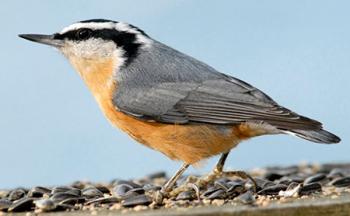
450_jim-williams_red-breasted-nuthatch

Red-breasted Nuthatch.
Photo credit: Jim Williams

 
by Val Cunningham
Contributing Writer

These long-billed, active little birds zigzag all over a tree in search of a meal, sounding like tiny tin horns as they stay in contact with their kind.

A group of bird watchers walked the trails at Tamarack Nature Center recently, on the lookout for late migrants as well as birds that will be around all winter. We’d come to this large park in White Bear Township because it often produces some pleasant surprises.

Motion and commotion up ahead soon caught our eyes, compelling us to stop and watch a fascinating display of avian foraging in a stand of spruce trees.

Small birds flitted in and out of the branches, and a constant “buh-Dee, buh-Dee” call quickly identified many as black-capped chickadees. But a few even smaller birds were mixed in with the ‘dees, birds with lovely blue-gray backs and dramatically striped faces.

These small birds were communicating with each other, too, and it was their calls, almost more than their plumage pattern, that pinpointed their identification. Yes, these were red-breasted nuthatches, the short-tailed smaller cousins of the familiar white-breasted bird, a fine reward in the middle of a long bird-watching tromp. They sound a bit like the larger nuthatches, although their call is higher pitched and more nasal. Hear the red-breasted variety here. Now compare their call to the white-breasted nuthatch’s, here.

Seed whackers

We stood and watched for many minutes, transfixed by the sight of the chickadees exploring needles and branches for small insects and nuthatches landing on spruce cones, jabbing their long beaks inside to extract a plump seed. With a spruce seed clamped in their bill, they’d flit to a nearby oak tree to either eat the meat or tap the seed into the bark for later consumption.

Both kinds of nuthatches are named for the way they approach seed consumption. Unlike chickadees, who hold a food item with both feet and hammer it with their beaks, nuthatches wedge a seed into bark and hack it into manageable pieces. The “hatch” in their names suggests that hacking activity.

The red-breasted kind are more lively than their cousins, moving rapidly up, down and across a branch or tree trunk, zigzagging and issuing frequent squeaky calls to keep in touch with their companions. (White-breasteds are known for their slower, head-down spiral down tree trunks, and for a lower-pitched “yank, yank” call). The red-breasteds are also bolder, seeming almost tame around feeding stations, allowing humans to approach closely before flying off. Some people even train them to eat out of their hands.

Both kinds are often found in a mixed flock of birds foraging together, with vocal little chickadees leading nuthatches, kinglets and downy woodpeckers through the woods.

Winter visitor

Red-breasted nuthatches breed in Canadian forests, then some migrate to spend the winter in our state, especially if food sources are scarce in the north. When conditions are bad, such as when the cone crop fails and/or the weather is particularly vile, great numbers of red-breasted nuthatches flood southward, a movement called an irruption. Last winter saw a major irruption of nuthatches all over the United States and some of those birds may still be in our area.

Since irruptions tend to occur every 2 to 4 years, we may not see great numbers of these handsome little birds this fall and winter. Still, it’s worth looking for them when you’re outdoors. Check stands of conifers in parks and woodlands (and even evergreens around parking lots), and keep an eye on your suet and seed feeders this winter. One or more of these “talkative, irrepressible woodland gnomes” (as Winsor Marrett Tyler describes them in Life History of North American Birds) might drop in to ‘hatch a snack.

St. Paul, Minn., resident Val Cunningham, who leads bird hikes for the St. Paul Audubon Society and writes about nature for local, regional and national newspapers and magazines.

Bird Spotlight

  • Red-Bellied WoodpeckerJanuary 29, 2014 - 5:42 pm
  • 8 Ways to Help BirdsDecember 29, 2013 - 5:20 pm
  • The Squeaky Bird of the ForestNovember 16, 2013 - 7:20 pm
  • Bird World Changes With the SeasonsOctober 16, 2013 - 7:48 pm
  • A River of Birds Stream by at NightSeptember 16, 2013 - 8:19 pm
  • Male Rose-breasted Grosbeak
    Grosbeaks are the Bandana BirdJuly 19, 2013 - 7:26 pm
  • Indigo Bunting
    Blue Indigos Catch the Eye — and EarJuly 19, 2013 - 7:12 pm
  • Very young red-tailed hawks
    Nest Cams Put You in the Catbird SeatJune 19, 2013 - 7:40 pm
  • Great-horned Owl
    It’s Hooting Season for Great-Horned OwlsFebruary 19, 2013 - 7:48 pm
  • male Pine Grosbeak
    Watch for Handsome, Hungry Winter FinchesJanuary 19, 2013 - 8:02 pm
  • White-breasted Nuthatch
    Birds Triumph Over the ColdDecember 20, 2012 - 6:47 pm
  • Downy Woodpecker at suet feeder
    Downies, the Pocket-Sized WoodpeckersNovember 20, 2012 - 6:54 pm
  • Scarlet Tanager
    Birds Eating WeirdlyOctober 20, 2012 - 7:22 pm
  • Sandhill Crane
    Cranes families are on the moveSeptember 20, 2012 - 7:35 pm
  • Pair of prothonotary warblers
    Songs subside as birds rear their youngJuly 20, 2012 - 7:45 pm
  • Blue Jays hash it out at feeder
    Blue Jays Get a Bad RapJune 21, 2012 - 3:25 pm
  • Tree Swallow nest
    The Incredible EggJune 21, 2012 - 3:21 pm
  • Male goldfinch feeds young
    Nature’s TurncoatsMay 21, 2012 - 3:32 pm
  • great horned owl
    Night’s silent hunters may live in your ‘hoodApril 21, 2012 - 4:07 pm
  • White-throated Sparrow
    Beautiful Springtime MusicApril 21, 2012 - 3:45 pm

Saint Paul Bird Alliance
P.O. Box 7275
St. Paul, MN 55107

Saint Paul Bird Alliance is a chapter of the National Audubon Society, Inc.

Donate to Saint Paul Bird Alliance >

Subscribe to The Cardinal newsletter >

Upcoming Events >

Contact Saint Paul Bird Alliance >

© Copyright - Saint Paul Bird Alliance 1945 - 2024. All Rights Reserved. | Powered by simpleDesigns
  • Link to Facebook
  • Link to X
  • Link to Youtube
Link to: Bird World Changes With the Seasons Link to: Bird World Changes With the Seasons Bird World Changes With the Seasons Link to: December 2013/January 2014 Link to: December 2013/January 2014 December 2013/January 2014
Scroll to top Scroll to top Scroll to top