
It’s Hooting Season for Great-Horned Owls
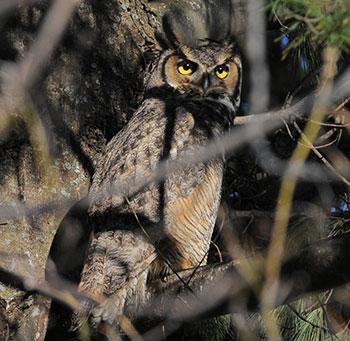
Great-horned Owl
Photo credit: Jim Williams
by Val Cunningham
Contributing Writer
Because their offspring have a long learning curve, our largest owls begin raising the next generation even as snow falls in the forest.
On a warm June morning, after a nighttime rain, I was walking through the woods in St. Paul’s Como Park when some motion caught my eye. Overhead, in a hackberry tree, two large great horned owl juveniles and a parent were shaking their feathers dry. Since they were perched right over a pathway and didn’t seem agitated, I returned several times over the next month to check on the owl family.
The young birds must have been perfecting their flight skills at night, because each day they were perched in a different tree, always with a watchful parent nearby. They dozed in the daytime, snapping awake if crows flew overhead or a squirrel landed in their tree. They left these woods after several weeks, but others spotted them at dusk within the park through much of the summer.
Take this as proof that great horned owls live among us, mostly invisibly, throughout the year.
Silent lives
Even in this popular park, the owl family remained unseen by most who walked under their tree, unaware of these predators in their midst. And that’s the way owls like it. These big birds prefer to escape human notice as they sleep away the daylight hours, waiting for the night shift.
Great horned owls are aggressive and powerful hunters, terrifying all but the largest creatures of the night. Flying squirrels soar to new sites as fast as they can, fearful of the big owls. The same is true for night-foraging rabbits, shrews and voles, weasels, bats and skunks. Since great horned owls may also hunt at dusk, they’ve been known to take woodchucks, egrets, ducks, great blue herons, and even Canada geese.
Raucous season
Most urban owls escape our attention, due to their secretive natures, but that’s about to change. Great horned owls are the earliest birds to nest in our region and their territorial and pair-bonding rituals in December and January are very noisy, even raucous (hear their sounds here). An owl pair may breed and nest in the same area for many years, but are limited by the fact that they don’t build their own nests. They must find a structure built the previous year by an industrious red-tailed hawk pair, or use an old Cooper’s hawk or great blue heron nest, even a squirrel leaf nest. They’re also known to nest in tree snags and large cavities.
Once they claim a nest, the owl pair engages in hooting duets to make sure other owls recognize that their territory is taken. Then, in February or March, the female begins laying eggs. Since it’s still very cold, she is bound to the nest for the next two months or so, except for quick hunting trips, during which the male spells her on the nest. Her mate hunts and brings her most of her food during this time of incubating eggs, then keeping chicks warm. As an owl hunkers down on the nest, the only thing visible may be those big ear tufts.
Why do these owls nest so early each year? Because it takes so long for youngsters to learn the skills that will allow them to survive on their own. Young owls learn to fly at about three months of age, but their parents will spend much of the summer teaching them life skills. Night hunting is much more difficult than hunting in the daytime, the trade-off being that there are fewer other predators sharing the night and an abundance of available prey.
So keep your eyes peeled for one or a pair of our largest owl, especially with breeding season right around the corner.
Did You Know?
Owls sightings in winter are not rare, even in the metro area. Barred owls are found along the river bottoms, and screech owls occasionally roost in wood duck houses, sometimes in mailboxes or newspaper tubes. But it’s the great horned owl that really delivers the big punch of amazement: These are massive birds, and if those big yellow eyes happen to swing your way, you may feel an involuntary shiver.
St. Paul, Minn., resident Val Cunningham, who leads bird hikes for the St. Paul Audubon Society and writes about nature for local, regional and national newspapers and magazines.