
Birds Eating Weirdly
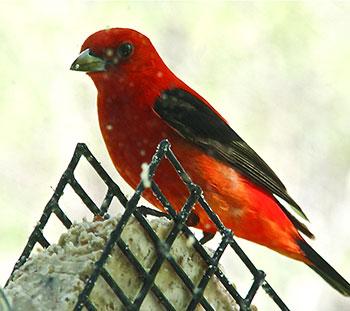
Scarlet Tanager
Photo credit: Laura Erickson
by Val Cunningham
Contributing Writer
Birds don’t always order off the regular menu, including a robin who makes his own jelly worms to orioles dining on corn on the cob.
Robins relish big, juicy earthworms, right? Well, how about the Elk River robin who visited a grape jelly feeder frequently this summer—and not just for a sweet treat. He’d dunk a freshly caught worm into the jelly, and then gulp it down. The reader who sent this tale noted, “We enjoyed watching this epicure enjoying his gourmet meal.”
We humans may have more rigid ideas about bird diets than birds themselves do. Many birds are eager learners when it comes to adding new items to their regimen. They watch each other, too, for clues about what’s good to eat, which is probably how the robin caught on to the jelly. He’d seen an oriole or catbird slurping up the purple stuff and decided to try adding a condiment to his invertebrate meal.
How about the south Minneapolis crows who gathered at a backyard picnic table for popcorn (unsalted) and fresh water? “They’d take the popcorn and either dump it into the water before eating it, or hold a kernel in their beaks and dunk it. This went on for 20 minutes and I was laughing out loud,” writes a crow fan.
A natural smorgasbord
Since crows are omnivores, the whole world must look like a smorgasbord to them, and another reader reported that her neighborhood crows relish the fish heads she leaves out after cleaning freshly caught fish. Crows also clog up her birdbath fountain when they wash pieces of roadkilled rabbit before eating.
We don’t think of cardinals as being flycatchers, but one reader reported seeing a cardinal fly out of a tree, “knock a butterfly to the ground, then pick it up and fly off.” Somehow this cardinal had learned that there was a high-protein meal between those butterfly wings, and either ate it himself or took it to his youngsters.
I’ve also observed a cardinal fluttering like a hummingbird near a hosta stalk in late fall, pulling out its large, luscious seeds to eat.
Orioles are associated in our minds with oranges and grape jelly, and they certainly do enjoy these treats, even though the bulk of their springtime diet is made up of insects. But one observer reported tossing some old, freezer-burned corn-on-the-cob onto the compost pile one April day, then looking out later to see six orioles busy at the corn: “They ate the cobs clean, and it took them a couple of hours,” she said.
Sweet treats
There are a number of reports of orioles visiting trumpet creeper flowers for nectar, either sipping it from the opening or puncturing a flower base to steal nectar from the bottom. Downy woodpeckers give themselves a sweet treat by sipping at hummingbird feeders.
Great blue herons are reported (and shown on YouTube) eating rabbits, ducks and gophers. I’ve also observed a large gang of these tall, wading birds following a harvesting tractor to snap up small rodents suddenly left without cover.
Sandhill cranes must love this time of year, with the woods full of a favorite treat. More than one reader has been disconcerted by the sight of these open-country birds strolling out of a forest after feasting on acorns. Turkeys also enjoy acorns and apparently are fans of clematis seeds as well: “They pull down my clematis vines right in front of me,” a reader reports.
When I think of goldfinches, I think of seeds, since this is one of the few birds that doesn’t vary its diet from season to season. But these small “wild canaries” have earned the nickname “lettuce finch” for their habit of eating lettuces and chard. “One was out there this morning, perched on the basil on his way to the chard,” a birdwatching gardener reports.
A few more reported oddities include a scarlet tanager carrying off a still-singing cicada, house finches nipping phlox buds and robins eating dry cat food.
There can be costs associated with unfamiliar foods—some things are downright poisonous and some, like monarch butterfly caterpillars, unpalatable. But there must be enough Andrew Zimmern in birds for them to try bizarre food from time to time.
Regular diets
For all those birds who want to stick to basics, please keep your feeders filled this fall and winter. Offer suet cakes (or raw suet, in cold weather) and shelled peanuts in wire mesh feeders for woodpeckers. Nyger seed or nyger mixed with sunflower chips will please the local finches, and offer safflower for many other songbirds, from cardinals to chickadees. And if you don’t mind the spilled shells, set out the most popular food of all, black oil sunflower seeds.
St. Paul, Minnesota resident Val Cunningham, leads bird hikes for the St. Paul Audubon Society and writes about nature for local, regional and national newspapers and magazines.