
Nature’s Turncoats
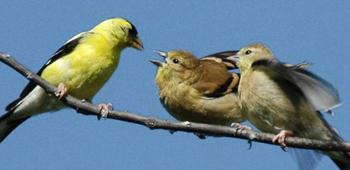
Male goldfinch feeds young
Photo credit: Jim Williams
by Val Cunningham
Contributing Writer
These “wild canaries” are highly social, spending most of their time feeding, flying and even sleeping as a flock.
Goldfinches have a strange, tie-dyed look these days, while they’re in the process of exchanging winter’s olive-drab feathers for a bright yellow coat. This happens slowly as spring advances, first with a few brilliant yellow feathers showing up on the throat, then the head, and finally the back. The birds look patchwork-y until mid-May, when we can step back and say, “The goldfinches are back.”
Of course, these chatty little finches have been around all winter, busily feeding from seed heads and feeders, but their cold-season look is so drab that they don’t look like summer’s birds. And truth to tell, the birds we see all winter may well be different from our summertime goldfinches. Our birds may drift southward while birds from farther north flock in to spend the winter. Now that spring is on its way, those northern visitors are moving back home, to be replaced by birds that will raise a family here.
It must be a relief to them to shed those winter feathers, something like the way we feel when we can pack away those heavy down parkas and bring out the tee-shirts and shorts. A goldfinch’s winter feathers are heavier and denser than summer’s, probably to provide more insulation.
Finch spring is later
No matter that cardinals and chickadees are singing merrily, it’s not really springtime on the goldfinch calendar. These small seedeaters are just about the last songbirds to nest each year, waiting until summer is well underway. Why does their breeding season begin at the hottest time of the year, after many other songbirds have already fledged a brood?
Here’s a hint: some people have suggested that a better name for these canary-like birds would be “thistle finches,” to suggest the important role this plant plays in their lives.
Like other songbirds, goldfinches change into breeding plumage, sing their species’s songs and select a mate in May or June, but they’re just going through the motions. Goldfinches wait until thistle is in bloom before they get serious about starting a family, partly because they like to use thistle down to line their small nest. And they know that when thistle blooms, thistle seeds aren’t far behind, assuring parent birds plenty of seed to feed their nestlings.
It’s all about the seeds
It’s this seedy diet that’s at the root of their procrastination. Unlike nearly all other songbirds, goldfinches don’t switch to a high-protein insect diet in spring and summer, nor do they feed their youngsters on energy-rich caterpillars and other insects. They use their tweezer-like beaks to pull seeds from summer’s thistle, dandelion, goats beard, grasses and garden plants, and turn to tree seeds and catkins in winter. Adults sometimes lick maple sap droplets, and some gardeners call them the “lettuce bird” for their habit of nibbling on tender beet and lettuce leaves.
They even feed their nestlings on seeds, but turn it into a sort of soup by mixing it with saliva, to make the seeds digestible.
It’s always cheering to see a crowd of bright yellow birds at the backyard feeders, as they jockey for position at the nyger and small sunflower seed feeders. These are very gregarious birds who spend most of their lives within a flock. Late summer is a pretty quiet season out in nature, after most birds have wrapped up the breeding season, but goldfinches are still singing away.
Not many birds sing while flying, but goldfinches do, chirping out their sweet “pa-diddle-ip” song as they undulate through the air. After the youngsters have fledged, the finches gather in fields and open areas in large feeding flocks. Their bills begin to darken and bit by bit the male’s brilliant yellow feathers disappear, replaced slowly by olive green plumage. And the cycle of the seasons continues.
Goldfinch etiquette
Some tips for keep goldfinches healthy at your feeders:
- Keep seed fresh and dry. Check feeders after rain and snowstorms, and toss any damp or clumping seed;
- Place finch feeders some distance from feeders for larger birds: goldfinches are easily bullied;
- Add perching spots near feeders (arbors, shrubs) so they can stack up as they wait a turn;
- Since they’re poopy little birds, wipe down the outside of feeders often and wash thoroughly every few weeks to inhibit the spread of disease.
St. Paul, Minnesota resident Val Cunningham, leads bird hikes for the St. Paul Audubon Society and writes about nature for local, regional and national newspapers and magazines.