
• Link to Facebook
  • Link to X
  • Link to Youtube
Saint Paul Bird Alliance
  • About
    • Who We Are
    • Chapter Leadership
    • Annual Reports
      • 2024-2025 Annual Report
      • 2023-2024 Annual Report
      • 2022-2023 Annual Report
      • 2021-2022 Annual Report
      • 2020-2021 Annual Report
      • 2019-2020 Annual Report
    • Finances
      • 2022-23 Financial Summary
      • 2023-2024 Financial Summary
      • 2025 – 2026 Budget
    • Board Minutes
      • Board Minutes 2024
        • Jan. 2024 Board Minutes
        • Feb. 2024 Board Minutes
        • March 2024 Board Minutes
        • April 2024 Board Minutes
        • May 2024 Board Minutes
        • Sept. 2024 Board Minutes
        • Oct. 2024 Board Minutes
        • Nov. 2024 – Board Minutes
        • Dec. 2024 Board Minutes
      • Board Minutes 2025
        • Jan. 2025 Board Minutes
        • Feb. 2025 Board Minutes
        • March 2025 Board Minutes
        • April 2025 Board Minutes
        • May 2025 Board Minutes
        • May 2025 Annual Meeting and Election Board Minutes
        • Sept. 2025 Board Minutes
        • Oct. 2025 Board Minutes
        • Nov. 2025 Board Minutes
        • Dec. 2025 Board Minutes
      • Board Minutes 2026
        • Jan. 2026 Board Minutes
        • Feb. 2026 Board Minutes
        • March 2026 Board Minutes
        • April 2026 Board Minutes
  • Events
  • Get Involved
    • Volunteer
    • St. Paul Bird Alliance Membership
    • Join National Audubon
  • Grants
    • Applying For A Grant
    • Grants in Action
  • Conservation Action
    • American Kestrel Nest Box Monitoring
    • Battle Creek Properties at Risk
  • News
    • News Blog
    • Archive: Newsletter
    • Subscribe
  • Contact Us
  • Click to open the search input field Click to open the search input field Search
  • Menu Menu

Big, Bright Birds

Baltimore Oriole

Baltimore Oriole
Photo credit: Jim Williams

 
by Val Cunningham
Contributing Writer

Returning migrants stand out in brilliant orange, red or blue coats as they settle in and advertise for a mate.

Migratory birds will soon flood into our region, eager to begin their annual rituals of selecting a territory and finding a mate. Many will stop only briefly on their way farther north, including most of the tiny warblers that flit quickly over bark and leaves in the hunt for high-energy insect larvae.

Several kinds of flycatchers, most of them on the small side and dressed in taupe or olive-colored plumage, hunt from tree perches for flying insects for a quick meal. Other early spring migrants also include the sweet-singing (but drab) thrushes and the fast-flying swallows.

But I have to admit a fondness for the return of big, flashy birds, the visible ones that couldn’t blend in with the foliage even if they tried.

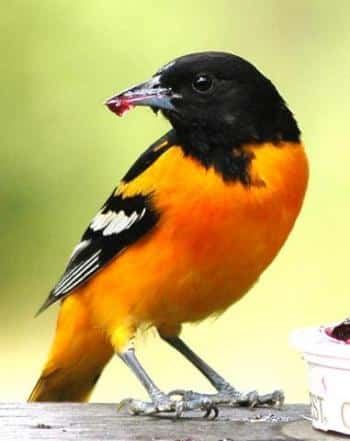
The bright orange-and-black Baltimore oriole, about the size of a cardinal, settles on the top of a tree, frequently near water to whistle his beautiful song. Males often engage in territorial disputes, chasing each other to and fro, making themselves even more conspicuous. These handsome birds are among the migrants that stop and raise their young in the metro area, and are known for their intricately woven nests hanging at the end of a branch.
Another good-sized bird shows up suddenly at feeders starting in mid-May. The handsome rose-breasted grosbeak, one of the sweetest singers on the block, sports a black back, white front and a rose-red bandana around its neck. You have to look closely for these cardinal-sized birds, though: even with such a high-contrast coat they can be strangely difficult to find.

A burry song from a tall tree signals the scarlet tanager’s return. About the size of a cedar waxwing, the tanager is an almost unbelievably neon-red bird. You won’t confuse it with a cardinal because tanagers lack a crest and their red is so much more intense. The tanager’s all-black wings are another distinguishing mark that says, “I am so not a cardinal.”

Spring is such a noisy season, filled with exuberant bird sounds, that it’s sometimes a challenge to single out one particular song. Especially if the singer knows up to 2,000 sounds, as the brown thrasher does, and links them together in always-varying melodic phrases. You’ll often find this large (blue jay size) cinnamon-colored bird with a very long tail at the top of a tree, running through his repertoire, or hunting insects on the ground.

Indigo buntings are due back soon from the Caribbean and Mexico to settle into fields and roadsides. The small and beautiful deep blue males, about the size of a goldfinch, can perch invisibly right over your head They only stand out in sunlight, when their feather structure reflects the light as a brilliant blue.

Billions of birds are winging into North America, eager to carve out some real estate as their own. They risk the often long, and always arduous, migration in order to take advantage of our region’s bloom of summer insects and longer days for foraging. They’ll stuff these down their youngster’s gullets, raise them fast, and by the time fall rolls around, be ready to head southward for another winter.

Enjoy the migrant birds while you can, knowing that these purposeful creatures are with us for only a short while each year.

St. Paul, Minnesota resident Val Cunningham, leads bird hikes for the St. Paul Audubon Society and writes about nature for local, regional and national newspapers and magazines.

Bird Spotlight

  • Red-Bellied WoodpeckerJanuary 29, 2014 - 5:42 pm
  • 8 Ways to Help BirdsDecember 29, 2013 - 5:20 pm
  • The Squeaky Bird of the ForestNovember 16, 2013 - 7:20 pm
  • Bird World Changes With the SeasonsOctober 16, 2013 - 7:48 pm
  • A River of Birds Stream by at NightSeptember 16, 2013 - 8:19 pm
  • Male Rose-breasted Grosbeak
    Grosbeaks are the Bandana BirdJuly 19, 2013 - 7:26 pm
  • Indigo Bunting
    Blue Indigos Catch the Eye — and EarJuly 19, 2013 - 7:12 pm
  • Very young red-tailed hawks
    Nest Cams Put You in the Catbird SeatJune 19, 2013 - 7:40 pm
  • Great-horned Owl
    It’s Hooting Season for Great-Horned OwlsFebruary 19, 2013 - 7:48 pm
  • male Pine Grosbeak
    Watch for Handsome, Hungry Winter FinchesJanuary 19, 2013 - 8:02 pm
  • White-breasted Nuthatch
    Birds Triumph Over the ColdDecember 20, 2012 - 6:47 pm
  • Downy Woodpecker at suet feeder
    Downies, the Pocket-Sized WoodpeckersNovember 20, 2012 - 6:54 pm
  • Scarlet Tanager
    Birds Eating WeirdlyOctober 20, 2012 - 7:22 pm
  • Sandhill Crane
    Cranes families are on the moveSeptember 20, 2012 - 7:35 pm
  • Pair of prothonotary warblers
    Songs subside as birds rear their youngJuly 20, 2012 - 7:45 pm
  • Blue Jays hash it out at feeder
    Blue Jays Get a Bad RapJune 21, 2012 - 3:25 pm
  • Tree Swallow nest
    The Incredible EggJune 21, 2012 - 3:21 pm
  • Male goldfinch feeds young
    Nature’s TurncoatsMay 21, 2012 - 3:32 pm
  • great horned owl
    Night’s silent hunters may live in your ‘hoodApril 21, 2012 - 4:07 pm
  • White-throated Sparrow
    Beautiful Springtime MusicApril 21, 2012 - 3:45 pm

Saint Paul Bird Alliance
P.O. Box 7275
St. Paul, MN 55107

Saint Paul Bird Alliance is a chapter of the National Audubon Society, Inc.

Donate to Saint Paul Bird Alliance >

Subscribe to The Cardinal newsletter >

Upcoming Events >

Contact Saint Paul Bird Alliance >

© Copyright - Saint Paul Bird Alliance 1945 - 2024. All Rights Reserved. | Powered by simpleDesigns
  • Link to Facebook
  • Link to X
  • Link to Youtube
Link to: Spring, the Singingest Season Link to: Spring, the Singingest Season Spring, the Singingest SeasonBlack-capped Chickadee Link to: June/July 2010 Link to: June/July 2010 June/July 2010
Scroll to top Scroll to top Scroll to top