
• Link to Facebook
  • Link to X
  • Link to Youtube
Saint Paul Bird Alliance
  • About
    • Who We Are
    • Chapter Leadership
    • Annual Reports
      • 2024-2025 Annual Report
      • 2023-2024 Annual Report
      • 2022-2023 Annual Report
      • 2021-2022 Annual Report
      • 2020-2021 Annual Report
      • 2019-2020 Annual Report
    • Finances
      • 2022-23 Financial Summary
      • 2023-2024 Financial Summary
      • 2025 – 2026 Budget
    • Board Minutes
      • Board Minutes 2024
        • Jan. 2024 Board Minutes
        • Feb. 2024 Board Minutes
        • March 2024 Board Minutes
        • April 2024 Board Minutes
        • May 2024 Board Minutes
        • Sept. 2024 Board Minutes
        • Oct. 2024 Board Minutes
        • Nov. 2024 – Board Minutes
        • Dec. 2024 Board Minutes
      • Board Minutes 2025
        • Jan. 2025 Board Minutes
        • Feb. 2025 Board Minutes
        • March 2025 Board Minutes
        • April 2025 Board Minutes
        • May 2025 Board Minutes
        • May 2025 Annual Meeting and Election Board Minutes
        • Sept. 2025 Board Minutes
        • Oct. 2025 Board Minutes
        • Nov. 2025 Board Minutes
        • Dec. 2025 Board Minutes
      • Board Minutes 2026
        • Jan. 2026 Board Minutes
        • Feb. 2026 Board Minutes
        • March 2026 Board Minutes
        • April 2026 Board Minutes
  • Events
  • Get Involved
    • Volunteer
    • St. Paul Bird Alliance Membership
    • Join National Audubon
  • Grants
    • Applying For A Grant
    • Grants in Action
  • Conservation Action
    • American Kestrel Nest Box Monitoring
    • Battle Creek Properties at Risk
  • News
    • News Blog
    • Archive: Newsletter
    • Subscribe
  • Contact Us
  • Click to open the search input field Click to open the search input field Search
  • Menu Menu

Horned Larks Coming Through
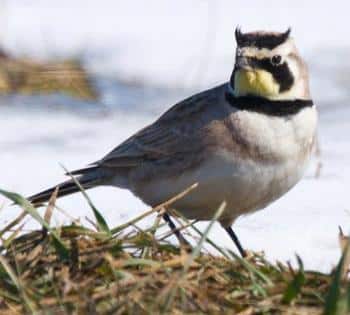
Horned lark

Horned lark
Photo credit: Ben Wilson

 
by Clay Christensen
Contributing Writer

My wife and I saw our first horned larks in Wabasha County, in southeastern Minnesota, in March 1988. As best we can recall, we were spending the weekend at a bed and breakfast and took an afternoon to drive around the county looking for birds. Neither of us remembers where we stayed, but we both remember the horned larks. What gorgeous birds!

At about seven inches in length, the horned lark looks like a smaller, slimmer version of a meadowlark. It sports that same V-necked sweater look. The male actually does have feathery “horns” on its head, above and behind the eyes, but they aren’t always displayed. The “horns” are joined by a black “sweatband” across the forehead.

The male horned lark also has a dark mask that droops down the cheek as well as that matching dark V-necked breast band. The chin and neck are yellow with a hint of yellow in the eyebrow. The back is brown, the underside is white. The female is similarly marked, but in very muted colors.

Some horned larks spend the winter in southern Minnesota, sometimes as far north as the Twin Cities. The horned larks that migrate south begin returning north into Minnesota in early February through late March. My buddies and I saw some at Lake Elmo Regional Park on March 14 this year.

I’ve found them most regularly along quiet country roads as the snow is just beginning to disappear from the fields. They’re usually pecking along the edges of a gravel road in small groups. They’re often fairly tame and just crouch when you approach. But as you get closer, they lift up, skim over the field, then drop suddenly and melt into the ground color.

They’ve been known to sit still for as long as five minutes. If you watch very carefully, especially if you scan slowly with binoculars, you will see them begin to run and stop, run and stop, along the furrows, like robins would.

Horned larks have a very horizontal posture, running with the head down. They look more like a mouse than a bird. Their song is a very high-pitched tinkley sound, often hard to hear.

For its courtship display, the male sings while it ascends to about 800 feet, then circles and sings for up to several minutes before folding its wings and diving headfirst toward the ground. It flares out at the last second, puffs up its chest, droops its wings and raises its horns to strut before the female.

The horned larks passing through Minnesota are usually heading for far northern Canada, to the tundra, where the Arctic wind and long cold winters keep willows and birch trees no more than a few inches high. They prefer wide open spaces with little or scrubby vegetation.

When they’re on their breeding territory, their diet includes moths, butterflies, caterpillars, beetles, wasps, spiders, grasshoppers and large ants as well as the fruits and seeds of the bog bilberry.

But, since they migrate northward so early in the year, they have to be very resourceful at finding things to eat along the way. They really like winter corn fields where they pry cutworms out of the base of the corn plants. They also favor sod farms, athletic fields, the trimmed edges of airport runways…any place with very short grass.

While there’s still snow on the ground, they frequent feed lots and farmyards, looking for grain spills, and they especially like plowed fields that have been freshly spread with manure.

So, this spring when I drive down Roselawn Avenue and notice that pungent odor from the St. Paul Campus farm fields, I’ll slow down and look for horned larks creeping among the furrows. Depending on the wind direction, I may leave the windows rolled up.

Clay Christensen writes The Birdman of Lauderdale column which appears in the St. Anthony Park “Bugle,” where a version of this article first appeared.

Bird Spotlight

  • Red-Bellied WoodpeckerJanuary 29, 2014 - 5:42 pm
  • 8 Ways to Help BirdsDecember 29, 2013 - 5:20 pm
  • The Squeaky Bird of the ForestNovember 16, 2013 - 7:20 pm
  • Bird World Changes With the SeasonsOctober 16, 2013 - 7:48 pm
  • A River of Birds Stream by at NightSeptember 16, 2013 - 8:19 pm
  • Male Rose-breasted Grosbeak
    Grosbeaks are the Bandana BirdJuly 19, 2013 - 7:26 pm
  • Indigo Bunting
    Blue Indigos Catch the Eye — and EarJuly 19, 2013 - 7:12 pm
  • Very young red-tailed hawks
    Nest Cams Put You in the Catbird SeatJune 19, 2013 - 7:40 pm
  • Great-horned Owl
    It’s Hooting Season for Great-Horned OwlsFebruary 19, 2013 - 7:48 pm
  • male Pine Grosbeak
    Watch for Handsome, Hungry Winter FinchesJanuary 19, 2013 - 8:02 pm
  • White-breasted Nuthatch
    Birds Triumph Over the ColdDecember 20, 2012 - 6:47 pm
  • Downy Woodpecker at suet feeder
    Downies, the Pocket-Sized WoodpeckersNovember 20, 2012 - 6:54 pm
  • Scarlet Tanager
    Birds Eating WeirdlyOctober 20, 2012 - 7:22 pm
  • Sandhill Crane
    Cranes families are on the moveSeptember 20, 2012 - 7:35 pm
  • Pair of prothonotary warblers
    Songs subside as birds rear their youngJuly 20, 2012 - 7:45 pm
  • Blue Jays hash it out at feeder
    Blue Jays Get a Bad RapJune 21, 2012 - 3:25 pm
  • Tree Swallow nest
    The Incredible EggJune 21, 2012 - 3:21 pm
  • Male goldfinch feeds young
    Nature’s TurncoatsMay 21, 2012 - 3:32 pm
  • great horned owl
    Night’s silent hunters may live in your ‘hoodApril 21, 2012 - 4:07 pm
  • White-throated Sparrow
    Beautiful Springtime MusicApril 21, 2012 - 3:45 pm

Saint Paul Bird Alliance
P.O. Box 7275
St. Paul, MN 55107

Saint Paul Bird Alliance is a chapter of the National Audubon Society, Inc.

Donate to Saint Paul Bird Alliance >

Subscribe to The Cardinal newsletter >

Upcoming Events >

Contact Saint Paul Bird Alliance >

© Copyright - Saint Paul Bird Alliance 1945 - 2024. All Rights Reserved. | Powered by simpleDesigns
  • Link to Facebook
  • Link to X
  • Link to Youtube
Link to: Highway Hawks Link to: Highway Hawks Highway HawksRed-tailed hawk Link to: April/May 2011 Link to: April/May 2011 April/May 2011
Scroll to top Scroll to top Scroll to top