
Blue Indigos Catch the Eye — and Ear
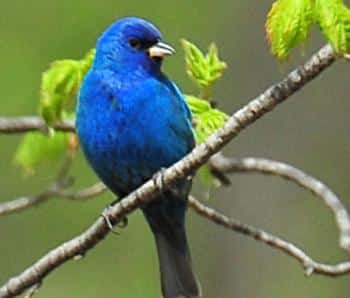
Gorgeous Indigo Buntings can be easy to spot when they’re out in the sunlight
Photo Credit: Jim Williams
by Val Cunningham
Contributing Writer
This little songster is heard more often than seen, but out in the sunlight on a summer’s day they’re among the most spectacular birds on the continent.
Blue is an unusual color in the avian world. Check off bluebirds, blue jays, tree swallows and two species of warblers and that’s most of the list.
But we shouldn’t forget one more, an often-overlooked but spectacular little bird, the indigo bunting, claimed by some as one of the most attractive birds in North America. Often called the “blue canary,” males perch at the top of a tall tree or shrub and sing their loud, repetitive song throughout the daylight hours. They sing all summer long, too, unlike most other songbirds, who turn silent after nesting season begins.
In the sunlight they’re a brilliant, turquoise blue, and this is probably the reason so many people are eager to see a bunting. They’re one of the most sought-after birds on spring and summer bird treks I lead: As we start out, someone invariably asks, with hope in his or her voice, “Will we see an indigo bunting?” And chances are, we will, because these birds are fairly abundant in the right habitat (woodlands, edges of weedy fields, utility wires) and they’re not skulkers. They’re easy to spot once you know what to look for—or really, listen for.
Track their sound
The best way to find a bunting is to first learn its song, usually a series of six notes—to some, they sound like a repetitive goldfinch. Even if the song varies a bit from bird to bird, the paired-note pattern holds true. Some say it sounds as if they’re singing “What, what, where, where, see it, see it.” (Hear an indigo bunting song here.
Once you know the song, you can home in on the sound and follow it to the bird. They’re very cooperative, singing from a perch for a long time, giving you plenty of chances to locate it. They’re most vocal at dawn, when a male may repeat his song many times a minute, then they slow to around one song a minute the rest of the day.
One challenge: in the shade, an indigo bunting is merely a small, charcoal-colored bird. It takes sunlight to turns his feathers the several shades of bright, electric blue that make it easy to see how this species got its name. The female indigo bunting is a very drab bird, often mistaken for a sparrow in her dull brown plumage.
Song school
Some birds, such as the Eastern phoebe and other flycatchers, hatch out of their eggs already knowing their species’s song—for them it’s innate. However, the male bunting only learns how to sound like other buntings by copying them after he leaves the nest. About half of the world’s birds are song learners, with some studying the songs of their fathers, while others learn from unrelated birds after they settle in an area. This is how buntings do it: they wait until they’ve chosen where to live before learning how to sing like their neighbors.
This means that buntings in one area all sound pretty much alike: they acquire the local dialect then can effectively communicate their territorial claims and courtship sounds to nearby buntings. Over time, that local song may gradually change, as one generation replaces the next, as Donald Kroodsma documents in his wonderful book, The Singing Life of Birds.
Like most other songbirds, buntings are on the hunt for insects and spiders in the summer, both to feed themselves and their nestlings. But once the young leave the nest, they’ll come to feeders to feast on nyger and safflower at bird feeders. They’re big fans of wild seeds, too, such as dandelion, thistle and goldenrod, and fruits like elderberries and serviceberries.
They’ll raise two broods here, and then they’re gone, departing in September for Mexico, Central America and the Caribbean.
Not truly blue
How do birds make blue feathers, when neither the foods they eat nor their own bodies can produce this color? Turns out it’s really a trick of the light: structures in their feathers bend light and reflect only the blue color, which is then what we see. This is true for Eastern blue birds, blue jays and indigo buntings. And it’s the reason that buntings in the forest are tough to spot. Without sunlight, they’re just a dark little bird with a big song.
St. Paul, Minn., resident Val Cunningham, who leads bird hikes for the St. Paul Audubon Society and writes about nature for local, regional and national newspapers and magazines.