
• Link to Facebook
  • Link to X
  • Link to Youtube
Saint Paul Bird Alliance
  • About
    • Who We Are
    • Chapter Leadership
    • Annual Reports
      • 2024-2025 Annual Report
      • 2023-2024 Annual Report
      • 2022-2023 Annual Report
      • 2021-2022 Annual Report
      • 2020-2021 Annual Report
      • 2019-2020 Annual Report
    • Finances
      • 2022-23 Financial Summary
      • 2023-2024 Financial Summary
      • 2025 – 2026 Budget
    • Board Minutes
      • Board Minutes 2024
        • Jan. 2024 Board Minutes
        • Feb. 2024 Board Minutes
        • March 2024 Board Minutes
        • April 2024 Board Minutes
        • May 2024 Board Minutes
        • Sept. 2024 Board Minutes
        • Oct. 2024 Board Minutes
        • Nov. 2024 – Board Minutes
        • Dec. 2024 Board Minutes
      • Board Minutes 2025
        • Jan. 2025 Board Minutes
        • Feb. 2025 Board Minutes
        • March 2025 Board Minutes
        • April 2025 Board Minutes
        • May 2025 Board Minutes
        • May 2025 Annual Meeting and Election Board Minutes
        • Sept. 2025 Board Minutes
        • Oct. 2025 Board Minutes
        • Nov. 2025 Board Minutes
        • Dec. 2025 Board Minutes
      • Board Minutes 2026
        • Jan. 2026 Board Minutes
        • Feb. 2026 Board Minutes
        • March 2026 Board Minutes
        • April 2026 Board Minutes
  • Events
  • Get Involved
    • Volunteer
    • St. Paul Bird Alliance Membership
    • Join National Audubon
  • Grants
    • Applying For A Grant
    • Grants in Action
  • Conservation Action
    • American Kestrel Nest Box Monitoring
    • Battle Creek Properties at Risk
  • News
    • News Blog
    • Archive: Newsletter
    • Subscribe
  • Contact Us
  • Click to open the search input field Click to open the search input field Search
  • Menu Menu

The Two Faces of House Wrens
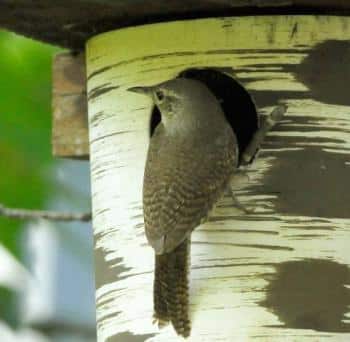
House Wren

House Wren
Photo credit: Jim Williams

by Val Cunningham
Contributing Writer

These tiny, energetic birds are a backyard favorite but it’s not surprising that bluebirds and chickadees consider them home wreckers.

Birds are singing from pre-dawn to post-dusk in a heady mixture of trills, chirps, whistles and buzzes. Our inner ears are primed for our favorite birds: “Oh, there’s an oriole,” or “Hey, that’s the indigo bunting!”

One fine day, usually around mid-May, a distinctive bubbly song announces that house wrens are back. Many people rejoice at the return of these small (under 5-in. long), active birds with their turned-up tails. I have to admit to mixed feelings about house wrens, but more about that later.

House wrens are little dynamos, hopping quickly through shrubs and vines, and, in woodlands, across toppled trees and branches. They’re very tolerant of humans and will nest in just about anywhere with the right overgrown habitat. For many people, this is their favorite bird: they like the wren’s confiding nature, jaunty cocked tail and loud, burbling song.

In fact, a friend advises anyone who puts up a wren house to make sure they like that distinctive song, “because you’re going to hear it all day long.”

Wrens don’t visit feeders, instead hunting spiders and insects such as beetles, bugs and various caterpillars. They stuff their nestlings with a similar diet, along with grasshoppers and crickets.

Real estate hogs

When it comes time to nest they search out tree holes, or crevasses in stone piles, even hollow logs. They ready use of nest boxes endears them to many people. Indeed, if you hang several nest boxes, a male wren will usually usurp every one. Males prepare a number of starter nests for a female’s consideration, stuffing all available cavities with 3- and 4-in. twigs. She does an inspection tour, then chooses a single cavity and finishes the nest herself.

The sticks aren’t the true nest, but form a platform for holding a small cup nest deep inside. This construction keeps the nestlings above rainwater or other seepage.

A finished nest might rest on hundreds of twigs, but consider the industrious wren who commandeered a wood duck box on a friend’s property—this large structure was stuffed to the roof with twigs— thousands and thousands of twigs. Wrens are also known to nest in old boots and shoes, flower pots and items left on out a clothesline.

Their dark side

Wrens covet all nest sites on their territory, and can become fierce pillagers of other birds’ nests. This is where they run afoul of some humans. A wren will enter a nest box already in use by another species and peck open the eggs by or will toss out nestlings. They’re notorious for ruining the nests of chickadees, bluebirds and tree swallows and even, at times, killing the adult birds. Wrens will even peck open eggs of birds that nest out in the open, like robins and cardinals, even though they have no use for the nest site.

This is the side of wrens that I don’t like, and explains why their exuberant song can sound both joyful and threatening. However, their behavior is part of the natural order of things, and serves to maximize their population. It’s incumbent on those of us who want to host bluebirds and chickadees to keep nest boxes away from woody areas, to discourage these small, fierce birds.

After nesting season wrens become secretive and silent, and many of us won’t even notice when they leave in September, heading for the southern United States or Mexico.

St. Paul, Minnesota resident Val Cunningham, leads bird hikes for the St. Paul Audubon Society and writes about nature for local, regional and national newspapers and magazines.

Bird Spotlight

  • Red-Bellied WoodpeckerJanuary 29, 2014 - 5:42 pm
  • 8 Ways to Help BirdsDecember 29, 2013 - 5:20 pm
  • The Squeaky Bird of the ForestNovember 16, 2013 - 7:20 pm
  • Bird World Changes With the SeasonsOctober 16, 2013 - 7:48 pm
  • A River of Birds Stream by at NightSeptember 16, 2013 - 8:19 pm
  • Male Rose-breasted Grosbeak
    Grosbeaks are the Bandana BirdJuly 19, 2013 - 7:26 pm
  • Indigo Bunting
    Blue Indigos Catch the Eye — and EarJuly 19, 2013 - 7:12 pm
  • Very young red-tailed hawks
    Nest Cams Put You in the Catbird SeatJune 19, 2013 - 7:40 pm
  • Great-horned Owl
    It’s Hooting Season for Great-Horned OwlsFebruary 19, 2013 - 7:48 pm
  • male Pine Grosbeak
    Watch for Handsome, Hungry Winter FinchesJanuary 19, 2013 - 8:02 pm
  • White-breasted Nuthatch
    Birds Triumph Over the ColdDecember 20, 2012 - 6:47 pm
  • Downy Woodpecker at suet feeder
    Downies, the Pocket-Sized WoodpeckersNovember 20, 2012 - 6:54 pm
  • Scarlet Tanager
    Birds Eating WeirdlyOctober 20, 2012 - 7:22 pm
  • Sandhill Crane
    Cranes families are on the moveSeptember 20, 2012 - 7:35 pm
  • Pair of prothonotary warblers
    Songs subside as birds rear their youngJuly 20, 2012 - 7:45 pm
  • Blue Jays hash it out at feeder
    Blue Jays Get a Bad RapJune 21, 2012 - 3:25 pm
  • Tree Swallow nest
    The Incredible EggJune 21, 2012 - 3:21 pm
  • Male goldfinch feeds young
    Nature’s TurncoatsMay 21, 2012 - 3:32 pm
  • great horned owl
    Night’s silent hunters may live in your ‘hoodApril 21, 2012 - 4:07 pm
  • White-throated Sparrow
    Beautiful Springtime MusicApril 21, 2012 - 3:45 pm

Saint Paul Bird Alliance
P.O. Box 7275
St. Paul, MN 55107

Saint Paul Bird Alliance is a chapter of the National Audubon Society, Inc.

Donate to Saint Paul Bird Alliance >

Subscribe to The Cardinal newsletter >

Upcoming Events >

Contact Saint Paul Bird Alliance >

© Copyright - Saint Paul Bird Alliance 1945 - 2024. All Rights Reserved. | Powered by simpleDesigns
  • Link to Facebook
  • Link to X
  • Link to Youtube
Link to: June/July 2010 Link to: June/July 2010 June/July 2010 Link to: Life in the Fast Lane Link to: Life in the Fast Lane Ruby-throated hummingbirdLife in the Fast Lane
Scroll to top Scroll to top Scroll to top