
• Link to Facebook
  • Link to X
  • Link to Youtube
Saint Paul Bird Alliance
  • About
    • Who We Are
    • Chapter Leadership
    • Annual Reports
      • 2024-2025 Annual Report
      • 2023-2024 Annual Report
      • 2022-2023 Annual Report
      • 2021-2022 Annual Report
      • 2020-2021 Annual Report
      • 2019-2020 Annual Report
    • Finances
      • 2022-23 Financial Summary
      • 2023-2024 Financial Summary
      • 2025 – 2026 Budget
    • Board Minutes
      • Board Minutes 2024
        • Jan. 2024 Board Minutes
        • Feb. 2024 Board Minutes
        • March 2024 Board Minutes
        • April 2024 Board Minutes
        • May 2024 Board Minutes
        • Sept. 2024 Board Minutes
        • Oct. 2024 Board Minutes
        • Nov. 2024 – Board Minutes
        • Dec. 2024 Board Minutes
      • Board Minutes 2025
        • Jan. 2025 Board Minutes
        • Feb. 2025 Board Minutes
        • March 2025 Board Minutes
        • April 2025 Board Minutes
        • May 2025 Board Minutes
        • May 2025 Annual Meeting and Election Board Minutes
        • Sept. 2025 Board Minutes
        • Oct. 2025 Board Minutes
        • Nov. 2025 Board Minutes
        • Dec. 2025 Board Minutes
      • Board Minutes 2026
        • Jan. 2026 Board Minutes
        • Feb. 2026 Board Minutes
        • March 2026 Board Minutes
        • April 2026 Board Minutes
  • Events
  • Get Involved
    • Volunteer
    • St. Paul Bird Alliance Membership
    • Join National Audubon
  • Grants
    • Applying For A Grant
    • Grants in Action
  • Conservation Action
    • American Kestrel Nest Box Monitoring
    • Battle Creek Properties at Risk
  • News
    • News Blog
    • Archive: Newsletter
    • Subscribe
  • Contact Us
  • Click to open the search input field Click to open the search input field Search
  • Menu Menu

Life in the Fast Lane
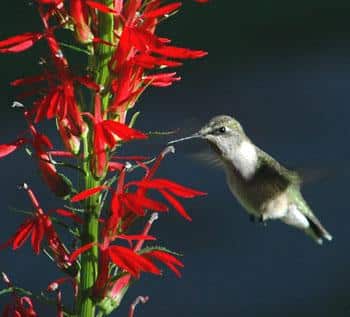
Ruby-throated hummingbird

Ruby-throated hummingbird
Photo credit: Val Cunningham

 
by Val Cunningham
Contributing Writer

Ruby-throated hummingbirds—among the feistiest birds around—have returned. They winged out of Central America about two weeks before they began appearing in backyards in early May. First to arrive were males, racing to claim a territory and get ready for females, who arrive a couple of weeks later. They battle and squabble with each other and anything else—you, the family dog or other birds—that strays into their feeding territories.

The little nectar sippers settle into some areas before any flowers are in bloom. They survive until bloom time by using an amazing strategy: they sip tree sap, unwittingly provided for them by yellow-bellied sapsuckers.

As the brightly marked woodpeckers chisel their sap wells into tree trunks, hummingbirds follow behind to lap up the liquid, which holds nearly the same sugar concentration as flower nectar. Small insects also are attracted to the sap wells, and hummingbirds lap these up, too, for a protein boost.

A single species

With something like 350 species of hummingbirds in the world, we must be content with just one—the ruby-throat. On the Wing’s contributors hear from people every summer who swear there are several different species of hummingbirds around their feeders. But, except for very rare cases, those “other” hummingbirds are still ruby-throats, albeit green-and-white females or juveniles.

With the fastest metabolism on earth, these little birds must refuel every 15 minutes on average. They’ve been compared to a car with a one-gallon gas tank, requiring many refueling stops.

Most of their daily calorie intake—about 75 percent—comes from flower nectar. When hummingbirds find a source of rich nectar, such as trumpet creeper vine flowers, they visit it frequently during the day.

Web masters

They’re also constantly on alert for protein, in the form of fruit flies, thrips, aphids and spiders—almost any insect small enough to be swallowed. Spiders are an important food item and a source of building supplies. Female hummingbirds pluck the long, nonsticky spider web strands to form her nest. She returns later for some of the sticky webbing to use as “glue” to attach camouflaging material, such as lichen, to the nest’s exterior,

Females handle all the nest-building and chick-rearing duties. They stuff their hatchlings with so many tiny insects and spiders that they’re ready to leave the nest in about three weeks’ time.

In our area, female ruby-throats generally raises two broods during the summer. The minute the first batch is able to fend for itself, she turns around and starts another nest. She often will be incubating eggs and feeding her early twins at the same time.

What can you do to help these hard-working little birds in this busy season? Hang nectar feeders and remember to clean them out every couple days, since sugar water spoils quickly in the heat. Provide a birdbath with a mist attachment, since hummingbirds don’t bathe like other birds but will fly through a mist. And plant things with tiny flowers, since these attract the tiny insects that make up a quarter of their diet.

And when making artificial nectar for hummingbird feeders, please don’t assume more sugar is better: the standard recommendation for 4 parts water to 1 part sugar is the best. A higher concentration of sugar could clog up their little tongues and throats.

St. Paul, Minnesota resident Val Cunningham, leads bird hikes for the St. Paul Audubon Society and writes about nature for local, regional and national newspapers and magazines.

Bird Spotlight

  • Red-Bellied WoodpeckerJanuary 29, 2014 - 5:42 pm
  • 8 Ways to Help BirdsDecember 29, 2013 - 5:20 pm
  • The Squeaky Bird of the ForestNovember 16, 2013 - 7:20 pm
  • Bird World Changes With the SeasonsOctober 16, 2013 - 7:48 pm
  • A River of Birds Stream by at NightSeptember 16, 2013 - 8:19 pm
  • Male Rose-breasted Grosbeak
    Grosbeaks are the Bandana BirdJuly 19, 2013 - 7:26 pm
  • Indigo Bunting
    Blue Indigos Catch the Eye — and EarJuly 19, 2013 - 7:12 pm
  • Very young red-tailed hawks
    Nest Cams Put You in the Catbird SeatJune 19, 2013 - 7:40 pm
  • Great-horned Owl
    It’s Hooting Season for Great-Horned OwlsFebruary 19, 2013 - 7:48 pm
  • male Pine Grosbeak
    Watch for Handsome, Hungry Winter FinchesJanuary 19, 2013 - 8:02 pm
  • White-breasted Nuthatch
    Birds Triumph Over the ColdDecember 20, 2012 - 6:47 pm
  • Downy Woodpecker at suet feeder
    Downies, the Pocket-Sized WoodpeckersNovember 20, 2012 - 6:54 pm
  • Scarlet Tanager
    Birds Eating WeirdlyOctober 20, 2012 - 7:22 pm
  • Sandhill Crane
    Cranes families are on the moveSeptember 20, 2012 - 7:35 pm
  • Pair of prothonotary warblers
    Songs subside as birds rear their youngJuly 20, 2012 - 7:45 pm
  • Blue Jays hash it out at feeder
    Blue Jays Get a Bad RapJune 21, 2012 - 3:25 pm
  • Tree Swallow nest
    The Incredible EggJune 21, 2012 - 3:21 pm
  • Male goldfinch feeds young
    Nature’s TurncoatsMay 21, 2012 - 3:32 pm
  • great horned owl
    Night’s silent hunters may live in your ‘hoodApril 21, 2012 - 4:07 pm
  • White-throated Sparrow
    Beautiful Springtime MusicApril 21, 2012 - 3:45 pm

Saint Paul Bird Alliance
P.O. Box 7275
St. Paul, MN 55107

Saint Paul Bird Alliance is a chapter of the National Audubon Society, Inc.

Donate to Saint Paul Bird Alliance >

Subscribe to The Cardinal newsletter >

Upcoming Events >

Contact Saint Paul Bird Alliance >

© Copyright - Saint Paul Bird Alliance 1945 - 2024. All Rights Reserved. | Powered by simpleDesigns
  • Link to Facebook
  • Link to X
  • Link to Youtube
Link to: The Two Faces of House Wrens Link to: The Two Faces of House Wrens The Two Faces of House WrensHouse Wren Link to: Nature’s Nomads Link to: Nature’s Nomads Cedar WaxwingNature’s Nomads
Scroll to top Scroll to top Scroll to top