
Swan season is winter’s prelude
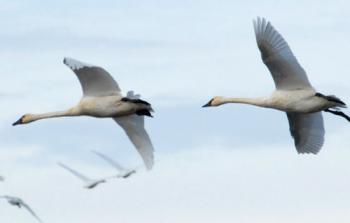
Tundra swans
Photo credit: Jim Williams
by Val Cunningham
Contributing Writer
Take a day trip to view dozens, even hundreds of tundra swans pausing on the Mississippi during migration—but hurry, they’ll soon be gone.
As autumn winds down, great white birds fly out of summer nesting grounds on the tundra near the Arctic Circle, towing winter behind them. For the next few weeks, tundra swans will be congregating on Mississippi River backwaters and pools, fattening up for the last leg of their journey. The best place to see thousands of swans at a time is outside Brownsville, Minn., near the Iowa border. But a shorter trip can be rewarding, too.
Just after Halloween birding message boards were reporting that the tundra swan-viewing season had begun. I hadn’t been to see these beautiful birds in five years and didn’t want any more time to slip away, so a friend and I set out south on Highway 61 in early November.
Tundra swans meandering along the river are a spectacular sight, worth several hours of driving to view them. Their long necks and big, tapered bodies are covered in shining feathers that seem almost improbably white, aligned so smoothly on their bodies they seem painted on. A leathery black bill and big black feet and legs are their only color. With a 7-ft. wingspan these swans are one of our continent’s largest birds, tipping the scales at around 15 lbs.
Wild swans are fascinating to watch, whether they’re bobbing on river channels, dabbling for underwater plants or flying stretched out, looking like long white arrows in the air. We stopped at Weaver Bottoms, about 120 miles south of the Twin Cities but as can happen, the swans were elsewhere that day. Just a bit further down the road, though, we found a group hugging the near shore just outside Minneiska (about 13 miles south of Wabasha).
For the next hour we watched up to 60 swans feeding, preening, dozing and swimming serenely between beds of reeds as the river sparkled under an unseasonably warm sun.
Tundras feed by dabbling as mallards do, submerging their heads and necks and tipping their tails up, to pull up wild celery and arrowhead tubers. They often loosen the plants by scrabbling the bottom with their big feet before scooping them up in their bills.
Swans honk to stay in touch with each other on the wing or warn away aggressive swans on the water (Listen to their call).
These are family-oriented birds, with adults establishing life-long pair bonds. A flock of tundra swans is really a number of family groups, usually Mom, Dad and two youngsters, called cygnets. It’s easy to distinguish young birds, with their dull, gray feathers, from their handsome parents.
We’re lucky to have these wild swans drop down for a feeding respite on their way to shallow waters from Chesapeake Bay to coastal North Carolina. I’d encourage bird fans to go downriver to see the swans while keeping an eye out for other birds: bald eagles fly over the backwaters regularly and perch in trees on the shore. Many different kinds of ducks hang out with the swans, some hoping for a stray bit of tuber to float their way.
Swan migration is an annual miracle—but a brief one. Swans are arriving and departing all the time during this period of open water. Once the backwaters freeze, the last will leave, flying to the coast in one long, unbroken flight.
Swan sites
To view swans by the hundreds, even thousands, travel about 170 miles south to Brownsville, Minn. The viewing platform on Highway 26 several miles south of town is the best spot to watch from.
If you’re content with a shorter trip for smaller numbers, then head down to Weaver Bottoms, about two hours from the Twin Cities on Highway 61. If no swans are visible, go a few more miles to Minneiska. That’s where we found about 60 swans not far from shore.
You can travel down the Wisconsin side as well, checking out backwaters between Nelson and Alma on Wisconsin 35. Stop at the viewing platform at Rieck’s Lake, three miles north of Alma, for information on swan locations. Although low swan numbers are being reported at Rieck’s Lake this year, visitors can get close-up views.
Have lunch at Alma or Wabasha, then round out the day by visiting Wabasha’s National Eagle Center to observe the resident eagles and learn more about our national bird (there is a fee to enter).
Two sites may be useful:
http://www.dnr.state.mn.us/birds/swans/tundra.html
http://almawisconsin.com/visitalma/birdinginalma.html