
• Link to Facebook
  • Link to X
  • Link to Youtube
Saint Paul Bird Alliance
  • About
    • Who We Are
    • Chapter Leadership
    • Annual Reports
      • 2024-2025 Annual Report
      • 2023-2024 Annual Report
      • 2022-2023 Annual Report
      • 2021-2022 Annual Report
      • 2020-2021 Annual Report
      • 2019-2020 Annual Report
    • Finances
      • 2022-23 Financial Summary
      • 2023-2024 Financial Summary
      • 2025 – 2026 Budget
    • Board Minutes
      • Board Minutes 2024
        • Jan. 2024 Board Minutes
        • Feb. 2024 Board Minutes
        • March 2024 Board Minutes
        • April 2024 Board Minutes
        • May 2024 Board Minutes
        • Sept. 2024 Board Minutes
        • Oct. 2024 Board Minutes
        • Nov. 2024 – Board Minutes
        • Dec. 2024 Board Minutes
      • Board Minutes 2025
        • Jan. 2025 Board Minutes
        • Feb. 2025 Board Minutes
        • March 2025 Board Minutes
        • April 2025 Board Minutes
        • May 2025 Board Minutes
        • May 2025 Annual Meeting and Election Board Minutes
        • Sept. 2025 Board Minutes
        • Oct. 2025 Board Minutes
        • Nov. 2025 Board Minutes
        • Dec. 2025 Board Minutes
      • Board Minutes 2026
        • Jan. 2026 Board Minutes
        • Feb. 2026 Board Minutes
        • March 2026 Board Minutes
        • April 2026 Board Minutes
  • Events
  • Get Involved
    • Volunteer
    • St. Paul Bird Alliance Membership
    • Join National Audubon
  • Grants
    • Applying For A Grant
    • Grants in Action
  • Conservation Action
    • American Kestrel Nest Box Monitoring
    • Battle Creek Properties at Risk
  • News
    • News Blog
    • Archive: Newsletter
    • Subscribe
  • Contact Us
  • Click to open the search input field Click to open the search input field Search
  • Menu Menu

The Snowbirds are Flooding In
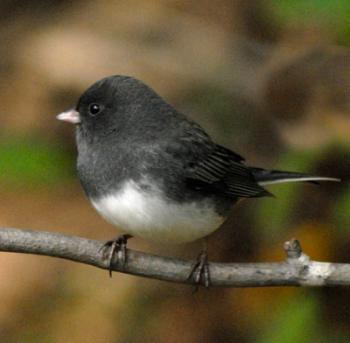
Junco

Junco
Photo Credit: Jim Williams

 
by Val Cunningham
Contributing Writer

For many of us, these small, dark sparrows seem to tow winter in their wake.

“If you see a junco, I don’t want to hear about it,” says a birding buddy on an early fall bird walk. But inevitably, by late September, even he had to face facts: the snowbirds had arrived on schedule, flooding in from the northern forests where they nested over the summer.

Juncos are small sparrows that resemble white birds wearing dark hoodies: they’re charcoal-colored on top with white undersides and a pale little beak (some describe the beak as pink). Their arrival along roadsides and in backyards in late fall is a sure sign that winter is on its way.

How do you know if the birds you’re seeing are juncos? Look at a small flock of dark birds busily foraging on the ground along a road or park path or under a tree. As you approach, if they sweep away flashing white feathers on each side of their tails, you can be sure they’re juncos. The white tail flash may be designed to startle a predator in pursuit or may signal aggression from one bird to another.

As social as they are, spending their days feeding and resting together, juncos have hierarchies, which are invisible to our eyes. The largest males feed at the center of a circle of foraging juncos. Off their shoulders are other, smaller males. Out at the edges are the females and young birds, who hold the lowest ranks. Why does position matter? Ground-feeders are particularly vulnerable to predators, from cats to hawks, and it’s those birds on the edge that are the least safe.

Mostly males

If you want to amaze your friends, point to a flock of these dark little birds, all of which are pretty similar, and say, “Oh, look at those male juncos.” You’re almost sure to be right, because in our northern region up to 80 percent of a flock will be males. Most females head farther south, and flocks in Southern states are made up mostly of females.

Like all sparrows, juncos are big fans of seeds, and they’re not very fussy. In fact, they’re one of the few birds that will eat those cheap supermarket mixes of sorghum and millet.

Kids often ask about this little bird’s odd name, wondering if it has anything to do with junk. The convoluted explanation: A German biologist back in the 1830s was studying junco specimens shipped from Mexico. He thought they resembled the European reed bunting, so drew from the Latin word for “rush,” juncus, and that’s how the junco got its name.

Even on the coldest winter days, juncos are out hopping over the snow or bare ground in search of seeds. And their odd little calls add some color to an otherwise silent season. Their “dik, dik, dik” call, a nasal chip note, sounds almost digital to me. They have a lovely trilling song, too, which we’ll hear in late winter, as they get ready to depart for points north.

To make life a little easier for these ground gleaners, you could toss some millet, cracked corn or other seeds on the ground or in a platform feeder. And to really put out the welcome mat, a brush pile offers shelter from wintry blasts. Throw some seed into the branches and juncos can feed in safety and relative warmth.

As much as many of us dread winter, think of these chipper snowbirds coming from the far north to escape the brutal winters and deep snow that covers their food sources. Minnesota is their Florida.

Bird Spotlight

  • Red-Bellied WoodpeckerJanuary 29, 2014 - 5:42 pm
  • 8 Ways to Help BirdsDecember 29, 2013 - 5:20 pm
  • The Squeaky Bird of the ForestNovember 16, 2013 - 7:20 pm
  • Bird World Changes With the SeasonsOctober 16, 2013 - 7:48 pm
  • A River of Birds Stream by at NightSeptember 16, 2013 - 8:19 pm
  • Male Rose-breasted Grosbeak
    Grosbeaks are the Bandana BirdJuly 19, 2013 - 7:26 pm
  • Indigo Bunting
    Blue Indigos Catch the Eye — and EarJuly 19, 2013 - 7:12 pm
  • Very young red-tailed hawks
    Nest Cams Put You in the Catbird SeatJune 19, 2013 - 7:40 pm
  • Great-horned Owl
    It’s Hooting Season for Great-Horned OwlsFebruary 19, 2013 - 7:48 pm
  • male Pine Grosbeak
    Watch for Handsome, Hungry Winter FinchesJanuary 19, 2013 - 8:02 pm
  • White-breasted Nuthatch
    Birds Triumph Over the ColdDecember 20, 2012 - 6:47 pm
  • Downy Woodpecker at suet feeder
    Downies, the Pocket-Sized WoodpeckersNovember 20, 2012 - 6:54 pm
  • Scarlet Tanager
    Birds Eating WeirdlyOctober 20, 2012 - 7:22 pm
  • Sandhill Crane
    Cranes families are on the moveSeptember 20, 2012 - 7:35 pm
  • Pair of prothonotary warblers
    Songs subside as birds rear their youngJuly 20, 2012 - 7:45 pm
  • Blue Jays hash it out at feeder
    Blue Jays Get a Bad RapJune 21, 2012 - 3:25 pm
  • Tree Swallow nest
    The Incredible EggJune 21, 2012 - 3:21 pm
  • Male goldfinch feeds young
    Nature’s TurncoatsMay 21, 2012 - 3:32 pm
  • great horned owl
    Night’s silent hunters may live in your ‘hoodApril 21, 2012 - 4:07 pm
  • White-throated Sparrow
    Beautiful Springtime MusicApril 21, 2012 - 3:45 pm

Saint Paul Bird Alliance
P.O. Box 7275
St. Paul, MN 55107

Saint Paul Bird Alliance is a chapter of the National Audubon Society, Inc.

Donate to Saint Paul Bird Alliance >

Subscribe to The Cardinal newsletter >

Upcoming Events >

Contact Saint Paul Bird Alliance >

© Copyright - Saint Paul Bird Alliance 1945 - 2024. All Rights Reserved. | Powered by simpleDesigns
  • Link to Facebook
  • Link to X
  • Link to Youtube
Link to: Swan season is winter’s prelude Link to: Swan season is winter’s prelude Swan season is winter’s preludeTundra swans Link to: December 2010/January 2011 Link to: December 2010/January 2011 December 2010/January 2011
Scroll to top Scroll to top Scroll to top