
Feathery Foster Care
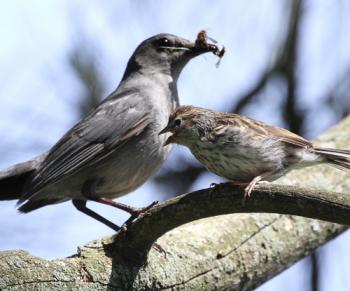
It’s not at all usual for one bird species to care for another but an adult catbird has decided to raise a tiny chipping sparrow
Photo credit: Don Severson
by Val Cunningham
Contributing Writer
Some bird behavior is driven by instinct, some is learned through experience, and some just seems plain quirky.
A pair of robins is raising four youngsters in the shaggy-looking nest they built on a beam that supports our front door overhang. This is an excellent spot for a nest, protected as it is from rain and marauding squirrels. But we’re not looking forward to the day, coming very soon, when the four spotty juveniles launch themselves into the world.
Robin parents are hyper-vigilant and there’ll be much squawking and screeching as the fledglings tumble to the ground and cling shakily to shrub branches for several days.
But this is what summer is all about for birds, a mad dash to lay and incubate eggs, feed and care for nestlings and push out as many offspring as they can before season’s end. Scenes like this are repeated all across our region, in backyards and parks, riversides and farm fields, even vacant lots.
Bluebirds and tree swallows commandeer nest boxes or tree holes and race in and out, carrying in insects, and then carrying out nestling poop. Starling teenagers fill the air with their unmusical bleats as they follow adults around from dawn to dusk, begging for a meal. Chickadee parents are run ragged as they search for small insects to feed as many as eight hungry youngsters.
Woodpecker parents appreciate suet cakes and shelled peanuts at feeders at this time of year, since these make it easier to satisfy their broods, growing up inside cavities in trees.
When avian youngsters jump out of the nest before they can fly, as many inevitably do, parent birds will come to them on tree perches or clothesline poles with their next meal.
Birds use instinct, intelligence and experience, sometimes alone, sometimes in combination, to meet life’s challenges. Occasionally there may be a short-circuit in this system, leading to unusual behavior that doesn’t quite fit the circumstance. Consider this strange but true tale of an adult bird that’s feeding a very young bird of another species, conveyed by Don Severson, a Wisconsin reader:
“A pair of adult chipping sparrows were feeding their youngster on the sidewalk when a catbird showed up and elbowed them out of the way,” Severson noted. “He’s taken over feeding chores and brings in insects and such large moths that I don’t see how the little one can swallow them.”
The parent chipping sparrows initially tried to “double team” the catbird at feeding time, but he’s so much bigger they eventually disappeared. Their tiny offspring now follows the catbird around, begging for a meal.
Something major must have happened to override the strong bond between a catbird parent and its own brood. Duluth ornithologist Laura Erickson speculates that the bird’s quirky behavior might be explained by the catbird having lost its nest to a predator or to a storm. It’s unusual to have documentation of this kind of oddity in the bird world, but Severson is an excellent photographer and keeps his eye on bird activities.
Some species, notably crows, have evolved a system in which young birds from a previous year’s nest help their parents raise the current brood. But the catbird clan isn’t known for this kind of “helper at the nest” style.
But there have been occasional reports, over time, of similar catbird behavior, including one of a catbird feeding a young flicker and another of a catbird feeding orphaned young cardinals. So we’re probably safe in concluding that catbirds have a particularly strong urge to nurture young birds. If a catbird loses its nest through misfortune, it may turn to adopting some other bird’s brood. Catbirds are probably not out trolling for birds to foster, but a match-up may occur if disaster strikes just when catbird parenting instincts are at their peak.
Most of the activity we see in our backyards at this time of year comes out of ancient rhythms and behaviors that evolved to perpetuate a species. It’s always good to keep your eyes open, however, because Mother Nature sometimes holds a surprise.
A helping hand for young birds
Sometimes young birds may need assistance from human helpers, but at other times they’re better off left alone. Here’s some advice from the Wildlife Rehabilitation Center of Minnesota:
- A tiny, featherless bird or one with fluffy, downy feathers shouldn’t be out of the nest. If you find such a youngster, carefully pick it up and place it back in its nest. Parent birds’ primary instinct is to raise their young and won’t reject it after such handling.
- Larger, fully feathered young birds often leave the nest before they’re able to fly—there’s not enough nest room for them to develop their flight feathers. These need from five to seven days of hopping around and being fed by parents before they can take off.
- Leave fledgling birds alone— they’re healthy and survive well on their own. BUT KEEP YOUR CAT (AND DOG) INDOORS AT THIS PRECARIOUS TIME.
- Call the Wildlife Rehabilitation Center, 651-486-9453, with any questions about young birds.

This young robin is old enough to leave its nest. Its parents will continue to feed and care for it.

This very young cardinal is too young to survive out of its nest and needs to be put back.
Photos courtesy of the Wildlife Rehabilitation Center.
St. Paul, Minnesota resident Val Cunningham, leads bird hikes for the St. Paul Audubon Society and writes about nature for local, regional and national newspapers and magazines.