
A loud call and a flash of blue
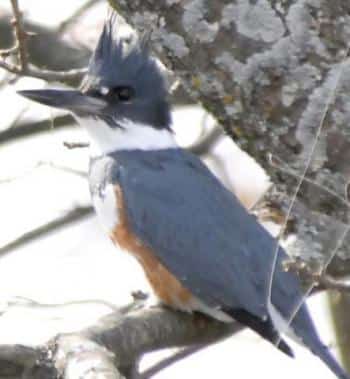
A female belted kingfisher waits for a fish to swim underneath her perch.
Photo credit: Jim Williams
by Val Cunningham
Contributing Writer
It’s sometimes easier to hear kingfishers than see them, but it’s well worth a search to discover these handsome fishing birds.
A flash of wings and an odd, jarring call announce the presence of one of nature’s zaniest birds. Most of us first encounter a kingfisher while walking near the shoreline of a lake, pond or river, when the peace is suddenly broken by a loud, rattling sound as a blue-gray rocket shoots briefly into view. Hugging the shoreline it quickly flaps around a bend, leaving a question in its wake: what was that?
The belted kingfisher can be an elusive bird, but with its fish-oriented diet it is invariably found near water. They’re about the size of a pigeon, but a large head and very short legs give them a top-heavy look. Their shaggy head crest reminds some of a Mohawk haircut. Add in a long, thick bill for snagging fish, a blue-gray necklace on a white front and deep, irregular wing beats and there’s no mistaking this bird for any other.
Even though guidebooks refer to the kingfisher as a common bird, they can be a challenge to find. When I encounter one, it’s usually perched on a tree limb extending over a clear lake or pond, or perching along a river or stream. They patrol their shoreline territory aggressively, and often give that distinctive, reverberating call as they fly from perch to perch. (Hear the kingfisher’s call here) The birds adopt favorite perching spots, keeping an eye on the water below.
It’s easy to tell the kingfisher genders apart, since this is one of the few bird species where the female is more brightly colored than the male. A blue-gray kingfisher with a single blue-gray stripe across its chest is a male. The female has that stripe plus a bright chestnut chest band and chestnut flanks.
Their nesting style is unique in the bird world—in fact, it’s more like a mammal. A pair digs a tunnel, which may extend up to 8 feet back into the bank along a stream or river. The nest chamber is at the end, up a slight slope, to keep it dry. The birds use their strong beaks and fused toes to shovel and rake material back to the entrance. The fact that the female is invisible to predators as she sits on her eggs deep inside a burrow may explain how she can afford to have bright plumage.
The young hatch inside their tunnel nest and spend their first weeks in the dark, eating fish brought by their parents. Once they leave the burrow, the noisy youngsters perch on branches along the stream, learning to forage by watching their parents drop dead fish for them to “catch” in the water.
Kingfishers are optimally designed to hover, wings flapping but head very still, above a pond in search of fish. Once their quarry is in sight, they dive headfirst into the water with only a small splash, an aerodynamic feat. In fact, when Japanese engineers went looking for a way to reduce the noise of sonic booms created as high-speed bullet trains emerge from tunnels, they studied the kingfisher. They were impressed by the bird’s ability to move from air to water without creating a big air cushion. Some new bullet trains now sport a long, tapered nose, modeled on a kingfisher head, muffling the booms that annoyed landowners and wildlife alike.
Most of our area’s kingfishers will disappear in autumn as they head to warmer places to spend the winter, but a few males remain near open water. These handsome birds with a unique lifestyle are well worth a search along our area’s waterways. And remember, you often hear a kingfisher before you see it.
Finding kingfishers
Some good places to look for kingfishers include any of the parks along the Mississippi River (including Fort Snelling State Park). Look around lakes (I’ve seen kingfishers in the Roberts Bird Sanctuary near Lake Harriet), along Minnehaha Creek and even around surprisingly small ponds and wetlands. The St. Croix and Minnesota riverbanks should deliver kingfisher sightings (or “hearings”), as well.
St. Paul, Minnesota resident Val Cunningham, leads bird hikes for the St. Paul Audubon Society and writes about nature for local, regional and national newspapers and magazines.