
• Link to Facebook
  • Link to X
  • Link to Youtube
Saint Paul Bird Alliance
  • About
    • Who We Are
    • Chapter Leadership
    • Annual Reports
      • 2024-2025 Annual Report
      • 2023-2024 Annual Report
      • 2022-2023 Annual Report
      • 2021-2022 Annual Report
      • 2020-2021 Annual Report
      • 2019-2020 Annual Report
    • Finances
      • 2022-23 Financial Summary
      • 2023-2024 Financial Summary
      • 2025 – 2026 Budget
    • Board Minutes
      • Board Minutes 2024
        • Jan. 2024 Board Minutes
        • Feb. 2024 Board Minutes
        • March 2024 Board Minutes
        • April 2024 Board Minutes
        • May 2024 Board Minutes
        • Sept. 2024 Board Minutes
        • Oct. 2024 Board Minutes
        • Nov. 2024 – Board Minutes
        • Dec. 2024 Board Minutes
      • Board Minutes 2025
        • Jan. 2025 Board Minutes
        • Feb. 2025 Board Minutes
        • March 2025 Board Minutes
        • April 2025 Board Minutes
        • May 2025 Board Minutes
        • May 2025 Annual Meeting and Election Board Minutes
        • Sept. 2025 Board Minutes
        • Oct. 2025 Board Minutes
        • Nov. 2025 Board Minutes
        • Dec. 2025 Board Minutes
      • Board Minutes 2026
        • Jan. 2026 Board Minutes
        • Feb. 2026 Board Minutes
        • March 2026 Board Minutes
        • April 2026 Board Minutes
  • Events
  • Get Involved
    • Volunteer
    • St. Paul Bird Alliance Membership
    • Join National Audubon
  • Grants
    • Applying For A Grant
    • Grants in Action
  • Conservation Action
    • American Kestrel Nest Box Monitoring
    • Battle Creek Properties at Risk
  • News
    • News Blog
    • Archive: Newsletter
    • Subscribe
  • Contact Us
  • Click to open the search input field Click to open the search input field Search
  • Menu Menu

Disappearing Act

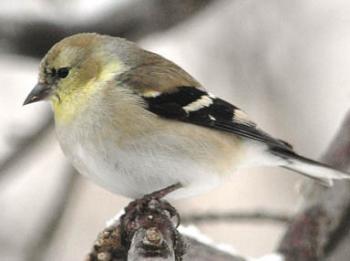
Male American Goldfinch in Winter

Male American Goldfinch in Winter
Photo Credit: Jim Williams
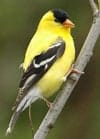
Male American Goldfinch in Summer

Male American Goldfinch in Summer.
Photo Credit: Jim Williams

 
by Val Cunningham
Contributing Writer

“Where have all the goldfinches gone?” people ask, lamenting the absence of these bright, chipper little birds at feeders and birdbaths now that winter is looming.

The truth is that goldfinches haven’t gone anywhere — like Poe’s purloined letter, they’re hiding in plain sight.

They have three ways of coming in under our radar. For one thing, they now look completely different from their summer selves. The males have exchanged their bright yellow feathers and black head spot for a warm taupe-colored plumage, and now resemble summer females. Just about the only sign that these little brownish birds are goldfinches is the distinctive white striping on black wings.

Another way they seem to disappear is through a shifting sort of migration. “Our” adult birds do head south, to be replaced by adults from farther north who move southward. There may be short periods when a neighborhood does lack goldfinches, but it’s a void quickly filled by new arrivals. In truth, there are many more goldfinches around now, summer’s population boosted by all the youngsters who fledged at the end of summer. These young birds don’t migrate in their first year, but they do wander around like nomads, setting down where they can find food, moving from feeder to feeder and neighborhood to neighborhood.

And finally, goldfinches are fiends for wild seed and may have temporarily abandoned feeding stations to feast on the wild seed crop wherever flower heads still stand. Autumn must be this bird’s favorite season: unlike most other songbirds, who consume large numbers of insects, goldfinches live on a nearly unvarying diet of seeds, seeds and more seeds. And fall is nature’s seediest season, with an abundant buffet in gardens and parks all over our area.

Finches flock to nodding heads of sunflower, black-eyed Susan, monarda, liatris, aster, sedum, Joe-pye Weed, coreopsis, and an apparent favorite, the several varieties of coneflower. They visit birch and cedar trees for seeds, as well. They’re not picky, just about any seed will do—they even gather at the gnarly heads of burdock thistle found along woodland edges and shorelines. Listen to a small group of finches sitting in a treetop and they literally seem to be calling, “SEE-eeed.”

They’ll hover briefly in front of a likely looking plant, then land on a stalk or twig and slide toward the seed source. They’re very agile little birds whose strong legs allow them to even cling upside down, if necessary, to extract high-energy treats. Their sharp beaks easily break open the outer shell, and then they swallow the nutmeat inside.

My neighborhood’s large public raingarden, installed by the city and the local watershed district, is a major goldfinch magnet. A passerby may scare up 20 to 30 chattering little birds from the large clumps of native plants at this popular feasting site.

Any day now, most of the area’s flower stalks will sport denuded seed heads. That’s when you’ll begin to see small, light-brown birds at the feeders, snapping up nyger, sunflower or safflower seed, and then heading to the birdbath for a drink (seed-eating is thirsty business). Look closely and you’ll see just a hint of yellow, and you’ll know that your goldfinches have “returned.”

St. Paul, Minnesota resident Val Cunningham, leads bird hikes for the St. Paul Audubon Society and writes about nature for local, regional and national newspapers and magazines.

Bird Spotlight

  • Red-Bellied WoodpeckerJanuary 29, 2014 - 5:42 pm
  • 8 Ways to Help BirdsDecember 29, 2013 - 5:20 pm
  • The Squeaky Bird of the ForestNovember 16, 2013 - 7:20 pm
  • Bird World Changes With the SeasonsOctober 16, 2013 - 7:48 pm
  • A River of Birds Stream by at NightSeptember 16, 2013 - 8:19 pm
  • Male Rose-breasted Grosbeak
    Grosbeaks are the Bandana BirdJuly 19, 2013 - 7:26 pm
  • Indigo Bunting
    Blue Indigos Catch the Eye — and EarJuly 19, 2013 - 7:12 pm
  • Very young red-tailed hawks
    Nest Cams Put You in the Catbird SeatJune 19, 2013 - 7:40 pm
  • Great-horned Owl
    It’s Hooting Season for Great-Horned OwlsFebruary 19, 2013 - 7:48 pm
  • male Pine Grosbeak
    Watch for Handsome, Hungry Winter FinchesJanuary 19, 2013 - 8:02 pm
  • White-breasted Nuthatch
    Birds Triumph Over the ColdDecember 20, 2012 - 6:47 pm
  • Downy Woodpecker at suet feeder
    Downies, the Pocket-Sized WoodpeckersNovember 20, 2012 - 6:54 pm
  • Scarlet Tanager
    Birds Eating WeirdlyOctober 20, 2012 - 7:22 pm
  • Sandhill Crane
    Cranes families are on the moveSeptember 20, 2012 - 7:35 pm
  • Pair of prothonotary warblers
    Songs subside as birds rear their youngJuly 20, 2012 - 7:45 pm
  • Blue Jays hash it out at feeder
    Blue Jays Get a Bad RapJune 21, 2012 - 3:25 pm
  • Tree Swallow nest
    The Incredible EggJune 21, 2012 - 3:21 pm
  • Male goldfinch feeds young
    Nature’s TurncoatsMay 21, 2012 - 3:32 pm
  • great horned owl
    Night’s silent hunters may live in your ‘hoodApril 21, 2012 - 4:07 pm
  • White-throated Sparrow
    Beautiful Springtime MusicApril 21, 2012 - 3:45 pm

Saint Paul Bird Alliance
P.O. Box 7275
St. Paul, MN 55107

Saint Paul Bird Alliance is a chapter of the National Audubon Society, Inc.

Donate to Saint Paul Bird Alliance >

Subscribe to The Cardinal newsletter >

Upcoming Events >

Contact Saint Paul Bird Alliance >

© Copyright - Saint Paul Bird Alliance 1945 - 2024. All Rights Reserved. | Powered by simpleDesigns
  • Link to Facebook
  • Link to X
  • Link to Youtube
Link to: December 2009/January 2010 Link to: December 2009/January 2010 December 2009/January 2010 Link to: Natty, Noisy Nuthatch Link to: Natty, Noisy Nuthatch White-breasted NuthatchNatty, Noisy Nuthatch
Scroll to top Scroll to top Scroll to top