
• Link to Facebook
  • Link to X
  • Link to Youtube
Saint Paul Bird Alliance
  • About
    • Who We Are
    • Chapter Leadership
    • Annual Reports
      • 2024-2025 Annual Report
      • 2023-2024 Annual Report
      • 2022-2023 Annual Report
      • 2021-2022 Annual Report
      • 2020-2021 Annual Report
      • 2019-2020 Annual Report
    • Finances
      • 2022-23 Financial Summary
      • 2023-2024 Financial Summary
      • 2025 – 2026 Budget
    • Board Minutes
      • Board Minutes 2024
        • Jan. 2024 Board Minutes
        • Feb. 2024 Board Minutes
        • March 2024 Board Minutes
        • April 2024 Board Minutes
        • May 2024 Board Minutes
        • Sept. 2024 Board Minutes
        • Oct. 2024 Board Minutes
        • Nov. 2024 – Board Minutes
        • Dec. 2024 Board Minutes
      • Board Minutes 2025
        • Jan. 2025 Board Minutes
        • Feb. 2025 Board Minutes
        • March 2025 Board Minutes
        • April 2025 Board Minutes
        • May 2025 Board Minutes
        • May 2025 Annual Meeting and Election Board Minutes
        • Sept. 2025 Board Minutes
        • Oct. 2025 Board Minutes
        • Nov. 2025 Board Minutes
        • Dec. 2025 Board Minutes
      • Board Minutes 2026
        • Jan. 2026 Board Minutes
        • Feb. 2026 Board Minutes
        • March 2026 Board Minutes
        • April 2026 Board Minutes
  • Events
  • Get Involved
    • Volunteer
    • St. Paul Bird Alliance Membership
    • Join National Audubon
  • Grants
    • Applying For A Grant
    • Grants in Action
  • Conservation Action
    • American Kestrel Nest Box Monitoring
    • Battle Creek Properties at Risk
  • News
    • News Blog
    • Archive: Newsletter
    • Subscribe
  • Contact Us
  • Click to open the search input field Click to open the search input field Search
  • Menu Menu

Young Birds Go to “Song School”
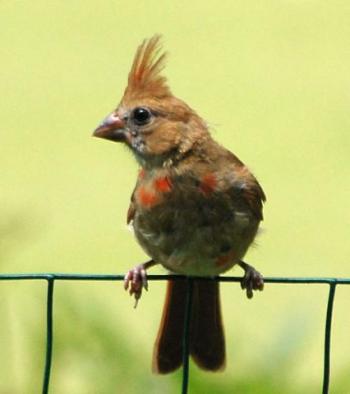
Juvenile Northern Cardinal

Juvenile Northern Cardinal
Photo credit: Jim Williams

 
by Val Cunningham
Contributing Writer

Time spent practicing pays off next year, when the best singers get the best territories and mates.

Heading into summer there’s a change in the mellifluous robin song of early spring. That easily recognized, smooth rendition of “cheerily, cheer-up, cheerio” has been replaced by something that sounds a bit more like a series of abruptly snapped off shrieks.

Bluebirds, too, sound different, more hesitant and a bit raspy. The towhees are singing out only a portion of their “drink your TEA” song — more like “drink your” — and chickadee sounds are clipped and nasal.

Why the change? Do the males only make sweet music while they’re setting up housekeeping with a female, then afterwards don’t put much heart into it? Turns out that the current singers are different birds than the ones that warbled during April and May.

Those springtime soloists were adult males, experts at vocalizing their species’s sounds. But the birds we hear most frequently in mid-summer are their sons, hatched just weeks ago and now in a hurry to learn to sound like an adult. They require a lot of practice, because their song is not instinctual. Because it’s not hard-wired into their brain, it must be learned.

Take the robins: youngsters hatch with an idea of their species’s repertoire, based on hearing their father sing. After leaving the nest, they practice all day long, comparing the sounds coming out of their beaks to their mental template of how a robin should sound. They keep it up until there’s a good match. Then the young robin, unlike nearly all other songbirds, does something extraordinary: he creates a song that’s uniquely his own, combining robin sounds in an individual way.

Other young birds, such as bluebirds, cardinals and chickadees, run through their practice endlessly, until they can duplicate their father’s song perfectly. And just like the kid down the block who’s learning to play the violin, listening to this can be painful.

Singing like dad

Songbirds are the song learners. Young males first learn to sing like their fathers, then, when setting up their own territories, they add on the “local dialect,” so they sound like their neighbors. Young birds start out babbling just as human babies do, soon after they leave the nest. At first they’re almost inaudible as they “whisper” their practice sounds. These become louder as the young birds become more proficient.

If you listen, late in the summer, you can hear young cardinal and oriole males engaging in song practice. These youngsters vocal learning sessions are a bit easier on the ear, not so much sung as whistled.

Summer’s endless practicing pays off the next spring, when a young bird sits on his territory for the first time. His ability to croon his species’s “This is mine, keep away!” song will help him hold a territory and attract a mate.

By the time they migrate out of the state in the fall, youngsters will have their songs stored accurately in their memories. Even if they don’t sing much or at all on their winter grounds, they’ll be ready to burst forth in recognizable song when they return next spring.

Attracting a mate and holding a territory are the two most important things a songbird does in its life. Since song is the key to success in both these fields, it’s no wonder that young birds spend so much time getting it right.

St. Paul, Minnesota resident Val Cunningham, leads bird hikes for the St. Paul Audubon Society and writes about nature for local, regional and national newspapers and magazines.

Bird Spotlight

  • Red-Bellied WoodpeckerJanuary 29, 2014 - 5:42 pm
  • 8 Ways to Help BirdsDecember 29, 2013 - 5:20 pm
  • The Squeaky Bird of the ForestNovember 16, 2013 - 7:20 pm
  • Bird World Changes With the SeasonsOctober 16, 2013 - 7:48 pm
  • A River of Birds Stream by at NightSeptember 16, 2013 - 8:19 pm
  • Male Rose-breasted Grosbeak
    Grosbeaks are the Bandana BirdJuly 19, 2013 - 7:26 pm
  • Indigo Bunting
    Blue Indigos Catch the Eye — and EarJuly 19, 2013 - 7:12 pm
  • Very young red-tailed hawks
    Nest Cams Put You in the Catbird SeatJune 19, 2013 - 7:40 pm
  • Great-horned Owl
    It’s Hooting Season for Great-Horned OwlsFebruary 19, 2013 - 7:48 pm
  • male Pine Grosbeak
    Watch for Handsome, Hungry Winter FinchesJanuary 19, 2013 - 8:02 pm
  • White-breasted Nuthatch
    Birds Triumph Over the ColdDecember 20, 2012 - 6:47 pm
  • Downy Woodpecker at suet feeder
    Downies, the Pocket-Sized WoodpeckersNovember 20, 2012 - 6:54 pm
  • Scarlet Tanager
    Birds Eating WeirdlyOctober 20, 2012 - 7:22 pm
  • Sandhill Crane
    Cranes families are on the moveSeptember 20, 2012 - 7:35 pm
  • Pair of prothonotary warblers
    Songs subside as birds rear their youngJuly 20, 2012 - 7:45 pm
  • Blue Jays hash it out at feeder
    Blue Jays Get a Bad RapJune 21, 2012 - 3:25 pm
  • Tree Swallow nest
    The Incredible EggJune 21, 2012 - 3:21 pm
  • Male goldfinch feeds young
    Nature’s TurncoatsMay 21, 2012 - 3:32 pm
  • great horned owl
    Night’s silent hunters may live in your ‘hoodApril 21, 2012 - 4:07 pm
  • White-throated Sparrow
    Beautiful Springtime MusicApril 21, 2012 - 3:45 pm

Saint Paul Bird Alliance
P.O. Box 7275
St. Paul, MN 55107

Saint Paul Bird Alliance is a chapter of the National Audubon Society, Inc.

Donate to Saint Paul Bird Alliance >

Subscribe to The Cardinal newsletter >

Upcoming Events >

Contact Saint Paul Bird Alliance >

© Copyright - Saint Paul Bird Alliance 1945 - 2024. All Rights Reserved. | Powered by simpleDesigns
  • Link to Facebook
  • Link to X
  • Link to Youtube
Link to: August/September 2010 Link to: August/September 2010 August/September 2010 Link to: The Journey Begins Link to: The Journey Begins Eastern TowheeThe Journey Begins
Scroll to top Scroll to top Scroll to top