
• Link to Facebook
  • Link to X
  • Link to Youtube
Saint Paul Bird Alliance
  • About
    • Who We Are
    • Chapter Leadership
    • Annual Reports
      • 2024-2025 Annual Report
      • 2023-2024 Annual Report
      • 2022-2023 Annual Report
      • 2021-2022 Annual Report
      • 2020-2021 Annual Report
      • 2019-2020 Annual Report
    • Finances
      • 2022-23 Financial Summary
      • 2023-2024 Financial Summary
      • 2025 – 2026 Budget
    • Board Minutes
      • Board Minutes 2024
        • Jan. 2024 Board Minutes
        • Feb. 2024 Board Minutes
        • March 2024 Board Minutes
        • April 2024 Board Minutes
        • May 2024 Board Minutes
        • Sept. 2024 Board Minutes
        • Oct. 2024 Board Minutes
        • Nov. 2024 – Board Minutes
        • Dec. 2024 Board Minutes
      • Board Minutes 2025
        • Jan. 2025 Board Minutes
        • Feb. 2025 Board Minutes
        • March 2025 Board Minutes
        • April 2025 Board Minutes
        • May 2025 Board Minutes
        • May 2025 Annual Meeting and Election Board Minutes
        • Sept. 2025 Board Minutes
        • Oct. 2025 Board Minutes
        • Nov. 2025 Board Minutes
        • Dec. 2025 Board Minutes
      • Board Minutes 2026
        • Jan. 2026 Board Minutes
        • Feb. 2026 Board Minutes
        • March 2026 Board Minutes
        • April 2026 Board Minutes
  • Events
  • Get Involved
    • Volunteer
    • St. Paul Bird Alliance Membership
    • Join National Audubon
  • Grants
    • Applying For A Grant
    • Grants in Action
  • Conservation Action
    • American Kestrel Nest Box Monitoring
    • Battle Creek Properties at Risk
  • News
    • News Blog
    • Archive: Newsletter
    • Subscribe
  • Contact Us
  • Click to open the search input field Click to open the search input field Search
  • Menu Menu

Along the Bluebird Trail
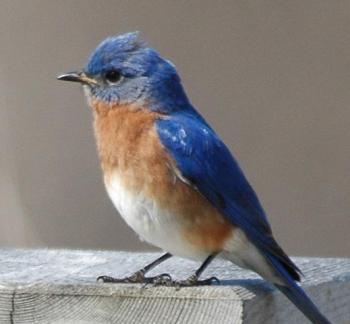
Eastern Bluebird

Eastern Bluebird
Photo credit: Jim Williams

 
by Val Cunningham
Contributing Writer

Humans are helping the robin’s beautiful cousin, once a rare sight, make an astounding comeback.

My bluebird season started on the last day in March, as I hiked around Como Park’s golf course, making sure all the sturdy cedar nest boxes were firmly mounted on their poles and ready for occupancy after the long winter.

The season ended four and a half months later, during the second week in August, when I cleaned out the last bedraggled clump of nesting material from one of the 15 boxes that make up my bluebird trail.

In between lay a summer of encouraging these beautiful blue thrushes to set up housekeeping by walking the trail each week, checking that weather and predators were being kept out, making minor repairs and booting out house sparrows whenever they took up residence.

Success doesn’t always come easy on my trail, with sparrows and occasional vandalism causing some nests to fail. But a total of 35 young bluebirds flew out of their nest structures and joined their parents in the big wide world over the summer. And the nearby bluebird trail within Como Park produced 42 young bluebirds, for a total of 77 for the park as a whole.

Many of your fellow Minnesotans volunteer as bluebird trail monitors each year. In 2009, more than 500 volunteers in the official Minnesota Bluebird Recovery Program reported nearly 21,000 newly minted young bluebirds emerging from nest boxes around the state.

“And that’s probably just the tip of the iceberg,” says Carrol Henderson, who directs the Department of Natural Resources’ Nongame Wildlife Program. “There easily could have been 100,000 to 150,000 new bluebirds fledged in 2009,” since many people set up and monitor nest boxes but don’t get around to filling out data forms.

Whatever the number, it’s a vast improvement from 50 years ago, when a bluebird sighting was a rare thing. Some passionate individuals set out in the 1970s to change things, forming bluebird societies and encouraging volunteers to put up nest boxes and monitor trails. The DNR’s Nongame Program held workshops and. Henderson himself produced an excellent book, Woodworking for Wildlife, Homes for Birds and Animals. The recent third edition spells out everything you need to know to be a good host to bluebirds.

A couple questions

Won’t bluebirds abandon their nests if their box is opened each week to check for signs of trouble? The answer is no, the birds are momentarily disturbed but quickly fly back in to tend eggs or nestlings.

How do other birds know that the nest boxes are intended for bluebirds? They don’t: various species of birds, such as tree swallows, wrens and chickadees, frequently adopt bluebird houses, and that’s just fine with us monitors. The one bird we won’t tolerate is the house sparrow, since this is a non-native species that attacks bluebirds, even kills them, to take over a box. (Sparrows are one of the reasons the small thrush’s numbers plummeted in the last century.)

Why place the nest boxes on a golf course? It turns out that golf courses (and cemeteries) offer ideal habitat for bluebirds—open areas with short grass that allow the birds to easily hunt ground-scuttling beetles and other insects.

As I walk in Como Park in early fall I can often hear the soft melodious song of a bluebird family talking to each other. Golfers are treated to the sight of bluebirds flitting from ground to nest box to feed the youngsters. Yes, bluebirds have come back from a time when their numbers got dangerously low.

It’s much more likely, these days, that you might spot a flash of brilliant blue and know you’re seeing a bird with a big fan club that’s continuing to bound back from the brink.

St. Paul, Minnesota resident Val Cunningham leads bird hikes for the St. Paul Audubon Society and writes about nature for local, regional and national publications.

Bird Spotlight

  • Red-Bellied WoodpeckerJanuary 29, 2014 - 5:42 pm
  • 8 Ways to Help BirdsDecember 29, 2013 - 5:20 pm
  • The Squeaky Bird of the ForestNovember 16, 2013 - 7:20 pm
  • Bird World Changes With the SeasonsOctober 16, 2013 - 7:48 pm
  • A River of Birds Stream by at NightSeptember 16, 2013 - 8:19 pm
  • Male Rose-breasted Grosbeak
    Grosbeaks are the Bandana BirdJuly 19, 2013 - 7:26 pm
  • Indigo Bunting
    Blue Indigos Catch the Eye — and EarJuly 19, 2013 - 7:12 pm
  • Very young red-tailed hawks
    Nest Cams Put You in the Catbird SeatJune 19, 2013 - 7:40 pm
  • Great-horned Owl
    It’s Hooting Season for Great-Horned OwlsFebruary 19, 2013 - 7:48 pm
  • male Pine Grosbeak
    Watch for Handsome, Hungry Winter FinchesJanuary 19, 2013 - 8:02 pm
  • White-breasted Nuthatch
    Birds Triumph Over the ColdDecember 20, 2012 - 6:47 pm
  • Downy Woodpecker at suet feeder
    Downies, the Pocket-Sized WoodpeckersNovember 20, 2012 - 6:54 pm
  • Scarlet Tanager
    Birds Eating WeirdlyOctober 20, 2012 - 7:22 pm
  • Sandhill Crane
    Cranes families are on the moveSeptember 20, 2012 - 7:35 pm
  • Pair of prothonotary warblers
    Songs subside as birds rear their youngJuly 20, 2012 - 7:45 pm
  • Blue Jays hash it out at feeder
    Blue Jays Get a Bad RapJune 21, 2012 - 3:25 pm
  • Tree Swallow nest
    The Incredible EggJune 21, 2012 - 3:21 pm
  • Male goldfinch feeds young
    Nature’s TurncoatsMay 21, 2012 - 3:32 pm
  • great horned owl
    Night’s silent hunters may live in your ‘hoodApril 21, 2012 - 4:07 pm
  • White-throated Sparrow
    Beautiful Springtime MusicApril 21, 2012 - 3:45 pm

Saint Paul Bird Alliance
P.O. Box 7275
St. Paul, MN 55107

Saint Paul Bird Alliance is a chapter of the National Audubon Society, Inc.

Donate to Saint Paul Bird Alliance >

Subscribe to The Cardinal newsletter >

Upcoming Events >

Contact Saint Paul Bird Alliance >

© Copyright - Saint Paul Bird Alliance 1945 - 2024. All Rights Reserved. | Powered by simpleDesigns
  • Link to Facebook
  • Link to X
  • Link to Youtube
Link to: October/November 2010 Link to: October/November 2010 October/November 2010 Link to: Crows are Nature’s Scamps Link to: Crows are Nature’s Scamps American crowsCrows are Nature’s Scamps
Scroll to top Scroll to top Scroll to top