
Perky and popular
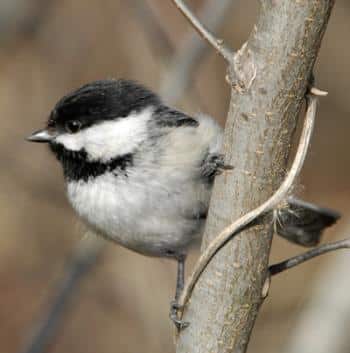
A black-capped chickadee, all bright eyes and strong feet, approaches life with boundless curiosity
Photo credit: Jim Williams
by Val Cunningham
Contributing Writer
Would chickadees be on most people’s ‘favorite bird’ lists if they were half as bouncy and endearing?
Chickadees are nature’s scamps, bringing what looks to us like joie de vivre to all their activities, masking the seriousness of the arduous tasks of daily survival. They’re superb athletes, the Nadia Comanecis of the bird world, sweeping toward feeders and perches, then dropping on a dime. Strong leg and foot muscles allow them to cling to small twigs in just about any pose—upside down, sideways, sometimes even right side up.
They’re curious, insouciant little animals, many people’s favorite bird, with an outsized courage compared to their diminutive bodies. When a group of songbirds gangs up to try to drive a hawk or owl out of an area, tiny chickadees join in, actively scolding and fluttering around the much larger raptor. They can be tough on their own kind, too, with ironclad rules dictating which ‘dees get to eat first or hold on to a territory.
Although we may think of them as chattering gaily within a flock, chickadees aren’t really social creatures. The groups of ‘dees we see in the winter operate under a strict social hierarchy with each chickadee keeping its proper distance. Within a chickadee pecking order, each bird knows its place, with lower-ranked birds deferring to those higher up the ladder. All it takes is one aggressive “gargle” call for ‘dees to sort themselves out.
Here are two telling chickadee stories passed on recently by readers: One man stored a spare house key inside his clothes pole’s cross pipe but was puzzled to find the key on the ground each morning. The mystery was solved one day when he observed a black-capped chickadee entering the pipe at sundown. The cross pipe was a perfect nighttime roost for the chickadee, after it kicked the annoying key out each evening.
Another backyard observer reports seeing a chickadee hanging from his calla lilies, hunting inside the long tubes for insects. The active little bird engaged in a great deal of clinging and fluttering, almost like a hummingbird.
These tales capture the intelligence and resourcefulness of these little birds. And they need these qualities, because the smaller the bird the tougher it is to survive outdoors, especially in winter. Weighing only a third of an ounce, chickadees are very hardy. They feed throughout the day, and then roost alone inside a tree cavity or other handy enclosure.
’Dees vigorously search tree bark and leaves for spiders and caterpillars, and fill in the chinks with fruit and seeds. A chickadee visiting a bird feeder in fall and winter may grab and hammer open as many as 250 sunflower seeds in one day—one seed every two and a half minutes. In winter they search out all those spots where they hid food the previous fall, remembering each and every one with the extra brainpower they add after the breeding season. It’s true: a chickadee’s brain grows larger in late summer to help it recall the locations of its hundreds of food caches.
Do chickadees migrate? Since they’re not strong flyers, they don’t migrate in the classic sense or even fly very far. Researchers have found that the average chickadee flight covers 40 feet or less. Every few years young birds may gather and move southward in the fall, a phenomenon called an irruption. Some may move back north again the next spring. Like all songbirds, finding and keeping a territory is key to a chickadee’s success in life.
As winter approaches, these little birds are busily hunting for and hiding food, and growing extra down feathers, perfect insulation against the coming cold.
Chickadees don’t lose a bit of their zip in winter, visiting feeders many times a day to pick out small morsels before dashing to perches to peck them into digestible bits. Well-stocked feeders help reduce the time they must spend foraging each day, and give a quick spurt of energy both at sunrise and before the long winter night.
Hand-held ‘dees
Chickadees are curious birds and it’s fairly easy to train them to feed from your hand, requiring only a bit of patience on your part. Stand outdoors near a feeder visited by chickadees, with some seed in your hand. (Some people start by placing a glove in the feeder, then after a few days, wearing the glove with seed in its palm.) Either way, it should require less than a half hour a day for about a week for a chickadee or two to land on your hand to pick up a seed. Their innate curiosity leads them to be among the first to try anything new.
St. Paul, Minnesota resident Val Cunningham, leads bird hikes for the St. Paul Audubon Society and writes about nature for local, regional and national newspapers and magazines.