
Finches Spread Like Wildfire
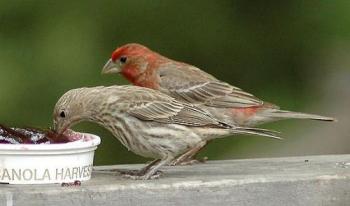
House Finches
Photo credit: Jim Williams
by Val Cunningham
Contributing Writer
Their beautiful, year-round song led to their appeal as caged birds, but they’ve emerged as the ultimate survivors.
That reddish finch at your feeders is an amazing bird, capable of great feats of resilience in the face of some very hard times. Consider its recent history: its ancestors were netted for years along the West Coast and sold, illegally, as caged birds, valued for their year-round singing. Transported, again illegally, to the East by pet dealers, some dozens were released around New York in the 1940s to avoid federal investigators.
Although thousands of miles from familiar habitat and facing cold winters, the birds did just fine. They not only survived, they thrived and soon had spread from the East Coast all the way to the Mississippi River with a population in the millions.
They came to our state late in the game, but were firmly established by the 1990s. What had been a Western bird now owned the East, as well. At its peak, in the mid-1990s, the house finch population was estimated in the hundreds of millions.
The Cornell Lab of Ornithology calls the spread of the house finch, “One of the most notable ornithological events of the twentieth century in North America.” No other bird has colonized such a wide area in so short a time in such huge numbers. These are social birds who congregate in large flocks, doubtless a factor in their survival.
Like all birds whose populations undergo major increases, this is a very adaptable species. House finches prefer to live near humans in parks, on farms and in urban and suburban areas. They’re big fans of bird feeders, especially those filled with black oiler sunflower or safflower seeds.
Not aliens
Unlike introduced species like the starling and house sparrow, the house finch is not an alien, it’s an out of place bird. Its recent history makes for an amazing saga and new chapters are still being written.
Several readers have reported seeing house finches with swollen, crusty eyes at their feeders. This is a symptom of a bacterial disease that infects the finches, causing conjunctivitis. It’s often fatal, since blind birds can’t see to escape predators or find food. Conjunctivitis swept through the house finch population, beginning in the mid-1990—just as their population was exploding, so was the disease. Some estimate that half of the house finch population disappeared by the year 2000. The disease seems to have leveled off but apparently will always be present at low levels.
Festive nests
Many people first encounter these handsome birds when they discover a house finch nest in a holiday wreath still hanging on a door in the spring, or find them nesting within a hanging basket. House finches are famous for raising their young in such places. They nest two or three times a season in our region, and turn out a large number of offspring.
Many are captivated by their exuberant, tumbling song, especially pleasing in the silence of late winter. It was the house finch’s song that made the bird so desirable to the caged bird trade, after all.
Has such a flood of birds pushed out any of our long-time residents? Since house finches and house sparrows share similar habitats and food, these birds do compete. Of more concern would their potential effect on goldfinches, and this is being watched. In the mid-90s, many of us bought “house finch-proof” feeders, that required birds to feed upside down, a trick goldfinches accomplish easily but the house finch hasn’t learned. Such feeders no longer seem necessary, with the house finch population stabilizing.
The “Hollywood finch” has had its ups and downs over the past 70 years on our side of the continent. But they’re still one of the most abundant birds at feeders from coast to coast. Amazing, considering that until the 1980s, no one in our area had ever seen a house finch in the wild.
If you see a finch with crusty eyes: First, don’t worry about catching the conjunctivitis yourself, it’s an avian disease. To keep it from spreading, take feeders down and give them a good cleaning, rinsing in a solution of 1 part chlorine bleach in 9 parts water, then rinsing again before drying. Do this every week or so for several weeks, then maintain a regime of regular feeder cleaning. Also rake up under feeders and toss that mixture of shells and poop in the trash.
Finches can be treated: House finch conjunctivitis is bad news for the birds, but now there’s a piece of good news: there is a new treatment that essentially cures the birds. If you see a house finch (or goldfinch) with swollen, crusty eyes at your feeder, and/or a finch that seems lethargic, try to catch it by slowly approaching from its blind side. The Wildlife Rehabilitation Center in Roseville will admit such finches and treats each one with antibiotics for a number of weeks, ending the bird’s status as a disease carrier.
St. Paul, Minnesota resident Val Cunningham, leads bird hikes for the St. Paul Audubon Society and writes about nature for local, regional and national newspapers and magazines.