
• Link to Facebook
  • Link to X
  • Link to Youtube
Saint Paul Bird Alliance
  • About
    • Who We Are
    • Chapter Leadership
    • Annual Reports
      • 2024-2025 Annual Report
      • 2023-2024 Annual Report
      • 2022-2023 Annual Report
      • 2021-2022 Annual Report
      • 2020-2021 Annual Report
      • 2019-2020 Annual Report
    • Finances
      • 2022-23 Financial Summary
      • 2023-2024 Financial Summary
      • 2025 – 2026 Budget
    • Board Minutes
      • Board Minutes 2024
        • Jan. 2024 Board Minutes
        • Feb. 2024 Board Minutes
        • March 2024 Board Minutes
        • April 2024 Board Minutes
        • May 2024 Board Minutes
        • Sept. 2024 Board Minutes
        • Oct. 2024 Board Minutes
        • Nov. 2024 – Board Minutes
        • Dec. 2024 Board Minutes
      • Board Minutes 2025
        • Jan. 2025 Board Minutes
        • Feb. 2025 Board Minutes
        • March 2025 Board Minutes
        • April 2025 Board Minutes
        • May 2025 Board Minutes
        • May 2025 Annual Meeting and Election Board Minutes
        • Sept. 2025 Board Minutes
        • Oct. 2025 Board Minutes
        • Nov. 2025 Board Minutes
        • Dec. 2025 Board Minutes
      • Board Minutes 2026
        • Jan. 2026 Board Minutes
        • Feb. 2026 Board Minutes
        • March 2026 Board Minutes
        • April 2026 Board Minutes
  • Events
  • Get Involved
    • Volunteer
    • St. Paul Bird Alliance Membership
    • Join National Audubon
  • Grants
    • Applying For A Grant
    • Grants in Action
  • Conservation Action
    • American Kestrel Nest Box Monitoring
    • Battle Creek Properties at Risk
  • News
    • News Blog
    • Archive: Newsletter
    • Subscribe
  • Contact Us
  • Click to open the search input field Click to open the search input field Search
  • Menu Menu

Urban Red-tails

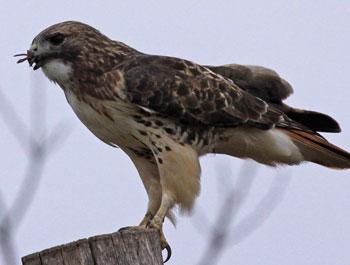
Red-tailed Hawk

Red-tailed Hawk
Photo credit: Laura Erickson

 
by Clay Christensen
Contributing Writer

As I drive the freeways here in the metro area, I often see a red-tailed hawk sitting atop a light pole, staring intently at the ground. It sometimes seems like a very casual, over-the-shoulder look. This is a classic sit-and-wait predator. From the back it’s usually dark brown with some lighter spots, often forming a V pattern. If it’s facing me, I can usually see a dark band around the belly (which we call a “belly band”).

In flight, you can see the rufous, reddish tail as the hawk turns in the sky. And the underside of the wings often shows dark “comma” or “parenthesis” marks out toward the wingtips.

Red-tailed hawks are the most common and widespread large hawks in North America, but also one of the most variable in coloration and markings. There are very dark varieties, very light varieties, and everything in between. That belly band, for example, isn’t always there, either. In fact, Birds of North America Online notes that there are up to 16 subspecies of red-tailed hawks.

The red-tailed hawk is one of our largest raptors, averaging about 19 inches long with a wingspread of nearly four feet. They weigh only two and a half pounds on average. The female is larger than the male. Red-tails are generally monogamous and have been known to live 21 years, but rarely beyond 17 years.

Red-tailed hawks build a sizable stick nest in the crotch of a large tree. The female begins laying eggs in mid- to late March, generally laying two or three eggs. Incubation lasts for 28 days. After hatching, the nestlings are fed chunks of rodents by both parents. The youngsters are ready to try flight after 42 to 46 days, but they remain with their parents for up to six months longer.

As I’ve noted, red-tails are classic sit-and-wait hunters. They watch for motion in the grasses and then drop and glide to pounce on unsuspecting prey.

Red-tailed hawks also hunt by soaring in circles above fields, using their telescopic vision to focus on a potential meal below. Red-tails eat rodents, rabbits, pheasants, quail, and even snakes.

One of the hazards when catching a rodent is the possibility of being bitten by your prey. Hawks are found with bite marks on their toes and legs from rodents and rabbits. It’s especially a problem with younger hawks that are still learning how to dispatch critters quickly.

The red-tail’s cry is a downward slurring “keer-r-r,” often featured in movies. I love it when the hero steps out onto a dusty cow town street and a red-tail cries somewhere above. Better than a loon, I guess.

Clay Christensen writes The Birdman of Lauderdale column which appears in the St. Anthony Park “Bugle,” where a version of this article first appeared.

Bird Spotlight

  • Red-Bellied WoodpeckerJanuary 29, 2014 - 5:42 pm
  • 8 Ways to Help BirdsDecember 29, 2013 - 5:20 pm
  • The Squeaky Bird of the ForestNovember 16, 2013 - 7:20 pm
  • Bird World Changes With the SeasonsOctober 16, 2013 - 7:48 pm
  • A River of Birds Stream by at NightSeptember 16, 2013 - 8:19 pm
  • Male Rose-breasted Grosbeak
    Grosbeaks are the Bandana BirdJuly 19, 2013 - 7:26 pm
  • Indigo Bunting
    Blue Indigos Catch the Eye — and EarJuly 19, 2013 - 7:12 pm
  • Very young red-tailed hawks
    Nest Cams Put You in the Catbird SeatJune 19, 2013 - 7:40 pm
  • Great-horned Owl
    It’s Hooting Season for Great-Horned OwlsFebruary 19, 2013 - 7:48 pm
  • male Pine Grosbeak
    Watch for Handsome, Hungry Winter FinchesJanuary 19, 2013 - 8:02 pm
  • White-breasted Nuthatch
    Birds Triumph Over the ColdDecember 20, 2012 - 6:47 pm
  • Downy Woodpecker at suet feeder
    Downies, the Pocket-Sized WoodpeckersNovember 20, 2012 - 6:54 pm
  • Scarlet Tanager
    Birds Eating WeirdlyOctober 20, 2012 - 7:22 pm
  • Sandhill Crane
    Cranes families are on the moveSeptember 20, 2012 - 7:35 pm
  • Pair of prothonotary warblers
    Songs subside as birds rear their youngJuly 20, 2012 - 7:45 pm
  • Blue Jays hash it out at feeder
    Blue Jays Get a Bad RapJune 21, 2012 - 3:25 pm
  • Tree Swallow nest
    The Incredible EggJune 21, 2012 - 3:21 pm
  • Male goldfinch feeds young
    Nature’s TurncoatsMay 21, 2012 - 3:32 pm
  • great horned owl
    Night’s silent hunters may live in your ‘hoodApril 21, 2012 - 4:07 pm
  • White-throated Sparrow
    Beautiful Springtime MusicApril 21, 2012 - 3:45 pm

Saint Paul Bird Alliance
P.O. Box 7275
St. Paul, MN 55107

Saint Paul Bird Alliance is a chapter of the National Audubon Society, Inc.

Donate to Saint Paul Bird Alliance >

Subscribe to The Cardinal newsletter >

Upcoming Events >

Contact Saint Paul Bird Alliance >

© Copyright - Saint Paul Bird Alliance 1945 - 2024. All Rights Reserved. | Powered by simpleDesigns
  • Link to Facebook
  • Link to X
  • Link to Youtube
Link to: April/May 2012 Link to: April/May 2012 April/May 2012 Link to: Beautiful Springtime Music Link to: Beautiful Springtime Music White-throated SparrowBeautiful Springtime Music
Scroll to top Scroll to top Scroll to top