
• Link to Facebook
  • Link to X
  • Link to Youtube
Saint Paul Bird Alliance
  • About
    • Who We Are
    • Chapter Leadership
    • Annual Reports
      • 2024-2025 Annual Report
      • 2023-2024 Annual Report
      • 2022-2023 Annual Report
      • 2021-2022 Annual Report
      • 2020-2021 Annual Report
      • 2019-2020 Annual Report
    • Finances
      • 2022-23 Financial Summary
      • 2023-2024 Financial Summary
      • 2025 – 2026 Budget
    • Board Minutes
      • Board Minutes 2024
        • Jan. 2024 Board Minutes
        • Feb. 2024 Board Minutes
        • March 2024 Board Minutes
        • April 2024 Board Minutes
        • May 2024 Board Minutes
        • Sept. 2024 Board Minutes
        • Oct. 2024 Board Minutes
        • Nov. 2024 – Board Minutes
        • Dec. 2024 Board Minutes
      • Board Minutes 2025
        • Jan. 2025 Board Minutes
        • Feb. 2025 Board Minutes
        • March 2025 Board Minutes
        • April 2025 Board Minutes
        • May 2025 Board Minutes
        • May 2025 Annual Meeting and Election Board Minutes
        • Sept. 2025 Board Minutes
        • Oct. 2025 Board Minutes
        • Nov. 2025 Board Minutes
        • Dec. 2025 Board Minutes
      • Board Minutes 2026
        • Jan. 2026 Board Minutes
        • Feb. 2026 Board Minutes
        • March 2026 Board Minutes
        • April 2026 Board Minutes
  • Events
  • Get Involved
    • Volunteer
    • St. Paul Bird Alliance Membership
    • Join National Audubon
  • Grants
    • Applying For A Grant
    • Grants in Action
  • Conservation Action
    • American Kestrel Nest Box Monitoring
    • Battle Creek Properties at Risk
  • News
    • News Blog
    • Archive: Newsletter
    • Subscribe
  • Contact Us
  • Click to open the search input field Click to open the search input field Search
  • Menu Menu

Grosbeaks are the Bandana Bird
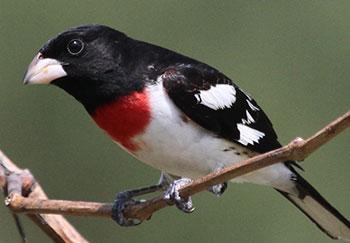
Male Rose-breasted Grosbeak

Male Rose-breasted Grosbeaks can be tough to spot as they skulk among tree leaves.
Photo credit: Don Severson

 
by Val Cunningham
Contributing Writer

Remember that Coasters tune with the refrain: “He wears a red bandana, plays a blues pianna, in a honky-tonk, down in Mexico?” Well, who’s to say the rock and roll group’s song doesn’t also refer to one of the most beautiful birds in backyard and woodlot—at least until you get to the ‘pianna’ part?

The male rose-breasted grosbeak is a big, boldly marked bird, with predominantly black and white plumage. And yes, the males do wear a red bandana—a distinctive triangle of red/pink feathers under the chin, and some even spend the winter in Mexico.

That red chest marking is so attention grabbing that we sometimes miss the reason the birds are called ‘grosbeaks’, that huge, pale beak that can crack the toughest nut. If it reminds you of a cardinal’s beak, that’s because the two birds are cousins, members of a vibrantly colored, big-beaked clan.

Male rose-breasted grosbeaks sing as beautifully as the Coasters do, too, and it’s often said their rich, sweet whistles sound like a robin who’s had singing lessons (hear them here).

The grosbeaks at your feeders have just returned from a winter-long sojourn in Mexico, Central America, Panama and northern South America, so they’re true long-distance migrants. They’ve survived an awe-inspiring migratory feat, flying nonstop across the 500+ mile Gulf of Mexico, before landing on U.S. soil.

A phenomenal sight

Some years ago, on a trip to the Florida Panhandle, several of us happened to be in the right place at the right time to observe a spectacular sight. After a stormy night, we drove to St. George Island, a thin spit of land just off the coast in the Gulf. Starting at about 9 a.m., birds began to drop down, exhausted after crossing the vast span of water: scarlet tanagers by the dozens, Baltimore orioles in profusion and more rose-breasted grosbeaks than I’d ever seen at one time. The poor birds were almost literally panting after such a long flight against the storm’s winds.

This phenomenon continued for several hours as birds reached the first landfall after their long journey, and we watched as the trees bent under the weight of so many bright birds. There must have been 30 orioles, 50 tanagers and 50 rose-breasted grosbeaks in view at a time, a sight I don’t expect I’ll ever encounter again.

Masters of invisibility

The only strike against this beautiful bird is its ability to hide so effectively. Once the trees leaf out in spring, grosbeaks can be heard singing their lovely song from the tree canopy, but can be nearly impossible to spot. It’s even harder to find female grosbeaks, brownish birds with brown-streaked breasts and a wide white “eyebrow.” They’re the ones who’ll be sitting on the nest, so it doesn’t pay to stand out the way males do.

Rose-breasted grosbeaks travel to our state to take advantage of spring and summer’s lush insect life. They feed these to their nestlings, and the high-protein diet builds strong bodies, allowing fledglings to grow fast and leave the nest quickly. Predators—cats, larger birds, squirrels, chipmunks and others—are always on the lookout for helpless young birds, so nestlings must grow quickly and leave the nest behind as soon as they’re able.

Grown-up grosbeaks consume many of the insects we consider harmful, such as beetles, ants and sawflies. They feast on berries in season, including elderberries, raspberries, mulberries and juneberries, and they’re fans of weed seeds and feeder seeds. They’re one of the few birds that I know of that eats milkweed seeds.

If you want to hear some beautiful harmonizing this spring and summer, stock your feeders with sunflower seeds. And consider planting some fruit-bearing shrubs and small trees to help them prepare for future fall migrations.

St. Paul, Minn., resident Val Cunningham, who leads bird hikes for the St. Paul Audubon Society and writes about nature for local, regional and national newspapers and magazines.

Bird Spotlight

  • Red-Bellied WoodpeckerJanuary 29, 2014 - 5:42 pm
  • 8 Ways to Help BirdsDecember 29, 2013 - 5:20 pm
  • The Squeaky Bird of the ForestNovember 16, 2013 - 7:20 pm
  • Bird World Changes With the SeasonsOctober 16, 2013 - 7:48 pm
  • A River of Birds Stream by at NightSeptember 16, 2013 - 8:19 pm
  • Male Rose-breasted Grosbeak
    Grosbeaks are the Bandana BirdJuly 19, 2013 - 7:26 pm
  • Indigo Bunting
    Blue Indigos Catch the Eye — and EarJuly 19, 2013 - 7:12 pm
  • Very young red-tailed hawks
    Nest Cams Put You in the Catbird SeatJune 19, 2013 - 7:40 pm
  • Great-horned Owl
    It’s Hooting Season for Great-Horned OwlsFebruary 19, 2013 - 7:48 pm
  • male Pine Grosbeak
    Watch for Handsome, Hungry Winter FinchesJanuary 19, 2013 - 8:02 pm
  • White-breasted Nuthatch
    Birds Triumph Over the ColdDecember 20, 2012 - 6:47 pm
  • Downy Woodpecker at suet feeder
    Downies, the Pocket-Sized WoodpeckersNovember 20, 2012 - 6:54 pm
  • Scarlet Tanager
    Birds Eating WeirdlyOctober 20, 2012 - 7:22 pm
  • Sandhill Crane
    Cranes families are on the moveSeptember 20, 2012 - 7:35 pm
  • Pair of prothonotary warblers
    Songs subside as birds rear their youngJuly 20, 2012 - 7:45 pm
  • Blue Jays hash it out at feeder
    Blue Jays Get a Bad RapJune 21, 2012 - 3:25 pm
  • Tree Swallow nest
    The Incredible EggJune 21, 2012 - 3:21 pm
  • Male goldfinch feeds young
    Nature’s TurncoatsMay 21, 2012 - 3:32 pm
  • great horned owl
    Night’s silent hunters may live in your ‘hoodApril 21, 2012 - 4:07 pm
  • White-throated Sparrow
    Beautiful Springtime MusicApril 21, 2012 - 3:45 pm

Saint Paul Bird Alliance
P.O. Box 7275
St. Paul, MN 55107

Saint Paul Bird Alliance is a chapter of the National Audubon Society, Inc.

Donate to Saint Paul Bird Alliance >

Subscribe to The Cardinal newsletter >

Upcoming Events >

Contact Saint Paul Bird Alliance >

© Copyright - Saint Paul Bird Alliance 1945 - 2024. All Rights Reserved. | Powered by simpleDesigns
  • Link to Facebook
  • Link to X
  • Link to Youtube
Link to: Blue Indigos Catch the Eye — and Ear Link to: Blue Indigos Catch the Eye — and Ear Blue Indigos Catch the Eye — and EarIndigo Bunting Link to: August/September 2013 Link to: August/September 2013 August/September 2013
Scroll to top Scroll to top Scroll to top