
• Link to Facebook
  • Link to X
  • Link to Youtube
Saint Paul Bird Alliance
  • About
    • Who We Are
    • Chapter Leadership
    • Annual Reports
      • 2024-2025 Annual Report
      • 2023-2024 Annual Report
      • 2022-2023 Annual Report
      • 2021-2022 Annual Report
      • 2020-2021 Annual Report
      • 2019-2020 Annual Report
    • Finances
      • 2022-23 Financial Summary
      • 2023-2024 Financial Summary
      • 2025 – 2026 Budget
    • Board Minutes
      • Board Minutes 2024
        • Jan. 2024 Board Minutes
        • Feb. 2024 Board Minutes
        • March 2024 Board Minutes
        • April 2024 Board Minutes
        • May 2024 Board Minutes
        • Sept. 2024 Board Minutes
        • Oct. 2024 Board Minutes
        • Nov. 2024 – Board Minutes
        • Dec. 2024 Board Minutes
      • Board Minutes 2025
        • Jan. 2025 Board Minutes
        • Feb. 2025 Board Minutes
        • March 2025 Board Minutes
        • April 2025 Board Minutes
        • May 2025 Board Minutes
        • May 2025 Annual Meeting and Election Board Minutes
        • Sept. 2025 Board Minutes
        • Oct. 2025 Board Minutes
        • Nov. 2025 Board Minutes
        • Dec. 2025 Board Minutes
      • Board Minutes 2026
        • Jan. 2026 Board Minutes
        • Feb. 2026 Board Minutes
        • March 2026 Board Minutes
        • April 2026 Board Minutes
  • Events
  • Get Involved
    • Volunteer
    • St. Paul Bird Alliance Membership
    • Join National Audubon
  • Grants
    • Applying For A Grant
    • Grants in Action
  • Conservation Action
    • American Kestrel Nest Box Monitoring
    • Battle Creek Properties at Risk
  • News
    • News Blog
    • Archive: Newsletter
    • Subscribe
  • Contact Us
  • Click to open the search input field Click to open the search input field Search
  • Menu Menu

Nature’s Nomads

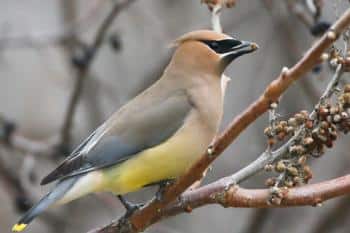
Cedar Waxwing

Cedar Waxwing
Photo Credit: Rebecca Field

 
by Val Cunningham
Contributing Writer

Breathtakingly beautiful Cedar Waxwings are “here today, gone tomorrow” birds, and the reason might surprise you.

Cedar waxwings may drop into your life for a moment, and then drop right out again. You’ll almost always hear them first, as these highly social birds stay connected to their flock via their high, thin calls. A group of waxwings then swoops into a tree or shrub and gobbles up its ripened fruit.

In summer they pluck serviceberries and mulberries, autumn finds them devouring mountain ash, dogwood and cedar berries and crabapples help them survive the winter.

Let’s stop right here and note the salient feature of these birds, which is their sheer physical beauty. Many people gasp when they see their first waxwing, stunned by the bird’s silky, Art Deco look. Their taupe, gray and yellow feathers are so sleek they look painted on. Add a handsome black mask over the eyes and just a suggestion of a head crest. They’re accessorized by a yellow stripe at the end of their tails and unique, waxy-looking red tips on their wings.

In fact, the birds are named for these red wingtips, resembling melted sealing wax, which are extensions of the feather shaft. Bird experts think the number of red tips may suggest a bird’s age to potential mates, and an older bird has more appeal than a younger one.

Waxwings are frugivores, one of the few North American birds whose diet is dominated by fruit: 80 percent berries, 20 percent insects. It’s this affinity for fruit that dictates much of their behavior.

They’re one of the last species to nest each summer, waiting until fruit is abundant before setting up housekeeping. If it’s not too late in the season when they finish up their brood, they’ll turn right around and raise a second nest of youngsters, although this is unusual at our latitude. We now know that nearly all songbirds raise their broods on an insect diet. Waxwings do this too, but only for the first few days, then they switch them to a fruit regime.

Fruit helps build and strengthen these social birds’ bond with their flock: they’ll perch side by side on a utility wire or tree limb and pass a berry from beak to beak down the line. This continues until one bird decides to eat the fruit.

In the scarcity of spring waxwings may augment their fruity diet by licking tree sap and eating fruit tree buds and flowers.

If you’re looking for cedar waxwings, keep an eye on a fruiting tree or shrub. If a waxwing spots it, it will send the news to its flock mates via their distinctive “seee” call. That sound is usually the first indication that waxwings are around. They converge on a fruit source, conversing in that whispery key while they eat. When the fruit is gone, they are, too, living the life of fruit-searching nomads.

The cedar waxwing call is a challenge to describe, but important for detecting the birds. It’s worth a visit to All About Birds to get familiar with their sounds. You may discover that you’ve heard one of nature’s handsomest birds without even realizing it.

St. Paul, Minnesota resident Val Cunningham, leads bird hikes for the St. Paul Audubon Society and writes about nature for local, regional and national newspapers and magazines.

Bird Spotlight

  • Red-Bellied WoodpeckerJanuary 29, 2014 - 5:42 pm
  • 8 Ways to Help BirdsDecember 29, 2013 - 5:20 pm
  • The Squeaky Bird of the ForestNovember 16, 2013 - 7:20 pm
  • Bird World Changes With the SeasonsOctober 16, 2013 - 7:48 pm
  • A River of Birds Stream by at NightSeptember 16, 2013 - 8:19 pm
  • Male Rose-breasted Grosbeak
    Grosbeaks are the Bandana BirdJuly 19, 2013 - 7:26 pm
  • Indigo Bunting
    Blue Indigos Catch the Eye — and EarJuly 19, 2013 - 7:12 pm
  • Very young red-tailed hawks
    Nest Cams Put You in the Catbird SeatJune 19, 2013 - 7:40 pm
  • Great-horned Owl
    It’s Hooting Season for Great-Horned OwlsFebruary 19, 2013 - 7:48 pm
  • male Pine Grosbeak
    Watch for Handsome, Hungry Winter FinchesJanuary 19, 2013 - 8:02 pm
  • White-breasted Nuthatch
    Birds Triumph Over the ColdDecember 20, 2012 - 6:47 pm
  • Downy Woodpecker at suet feeder
    Downies, the Pocket-Sized WoodpeckersNovember 20, 2012 - 6:54 pm
  • Scarlet Tanager
    Birds Eating WeirdlyOctober 20, 2012 - 7:22 pm
  • Sandhill Crane
    Cranes families are on the moveSeptember 20, 2012 - 7:35 pm
  • Pair of prothonotary warblers
    Songs subside as birds rear their youngJuly 20, 2012 - 7:45 pm
  • Blue Jays hash it out at feeder
    Blue Jays Get a Bad RapJune 21, 2012 - 3:25 pm
  • Tree Swallow nest
    The Incredible EggJune 21, 2012 - 3:21 pm
  • Male goldfinch feeds young
    Nature’s TurncoatsMay 21, 2012 - 3:32 pm
  • great horned owl
    Night’s silent hunters may live in your ‘hoodApril 21, 2012 - 4:07 pm
  • White-throated Sparrow
    Beautiful Springtime MusicApril 21, 2012 - 3:45 pm

Saint Paul Bird Alliance
P.O. Box 7275
St. Paul, MN 55107

Saint Paul Bird Alliance is a chapter of the National Audubon Society, Inc.

Donate to Saint Paul Bird Alliance >

Subscribe to The Cardinal newsletter >

Upcoming Events >

Contact Saint Paul Bird Alliance >

© Copyright - Saint Paul Bird Alliance 1945 - 2024. All Rights Reserved. | Powered by simpleDesigns
  • Link to Facebook
  • Link to X
  • Link to Youtube
Link to: Life in the Fast Lane Link to: Life in the Fast Lane Life in the Fast LaneRuby-throated hummingbird Link to: August/September 2010 Link to: August/September 2010 August/September 2010
Scroll to top Scroll to top Scroll to top