
• Link to Facebook
  • Link to X
  • Link to Youtube
Saint Paul Bird Alliance
  • About
    • Who We Are
    • Chapter Leadership
    • Annual Reports
      • 2024-2025 Annual Report
      • 2023-2024 Annual Report
      • 2022-2023 Annual Report
      • 2021-2022 Annual Report
      • 2020-2021 Annual Report
      • 2019-2020 Annual Report
    • Finances
      • 2022-23 Financial Summary
      • 2023-2024 Financial Summary
      • 2025 – 2026 Budget
    • Board Minutes
      • Board Minutes 2024
        • Jan. 2024 Board Minutes
        • Feb. 2024 Board Minutes
        • March 2024 Board Minutes
        • April 2024 Board Minutes
        • May 2024 Board Minutes
        • Sept. 2024 Board Minutes
        • Oct. 2024 Board Minutes
        • Nov. 2024 – Board Minutes
        • Dec. 2024 Board Minutes
      • Board Minutes 2025
        • Jan. 2025 Board Minutes
        • Feb. 2025 Board Minutes
        • March 2025 Board Minutes
        • April 2025 Board Minutes
        • May 2025 Board Minutes
        • May 2025 Annual Meeting and Election Board Minutes
        • Sept. 2025 Board Minutes
        • Oct. 2025 Board Minutes
        • Nov. 2025 Board Minutes
        • Dec. 2025 Board Minutes
      • Board Minutes 2026
        • Jan. 2026 Board Minutes
        • Feb. 2026 Board Minutes
        • March 2026 Board Minutes
        • April 2026 Board Minutes
  • Events
  • Get Involved
    • Volunteer
    • St. Paul Bird Alliance Membership
    • Join National Audubon
  • Grants
    • Applying For A Grant
    • Grants in Action
  • Conservation Action
    • American Kestrel Nest Box Monitoring
    • Battle Creek Properties at Risk
  • News
    • News Blog
    • Archive: Newsletter
    • Subscribe
  • Contact Us
  • Click to open the search input field Click to open the search input field Search
  • Menu Menu

Spring is Robin Season
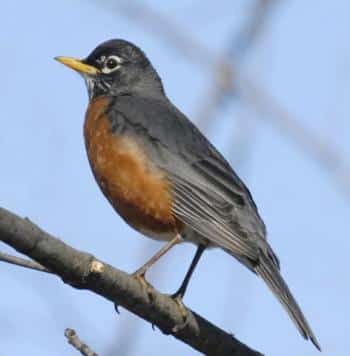
American Robin

American Robin
Photo credit: Jim Williams

 
by Val Cunningham
Contributing Writer

Spring moves toward us at its own plodding pace, “migrating” northward about 15 miles a day, a measure of the rate at which frost leaves the soil.

No beings know this better than the American robin, those big, bright thrushes that follow behind the spring thaw. In one of nature’s many synchronicities, robin migration coincides with earthworm migration. After a winter spent below ground, the worms rise to the surface once the soil is ice-free. Trailing behind the thaw on favorable winds, robins drop down in backyards, parks and boulevards ready to snap up shiny, brown worms as they emerge.

Let’s deal with a vexing question right away: robins are reported in our area throughout the winter, so how can they be called migrants? The answer is that robins are true migrants, with most of their populations moving north and then south with the seasons. A number of birds choose to trade the dangers of biennial journeys for the perils of a northern winter.

The new arrivals generally have had an easier time of it over the winter and it shows: their feathers seem almost new and many are just plain fat, there’s no kinder word. After gorging on worms and berries in the Gulf States and along the Atlantic coast, some arrive in nearly obese condition. Viewed from behind, these birds show orange ellipses of plumpness, bulging out from either side.

The rigors of defending a territory and the trials of the nesting season will soon pare these birds down to standard size.

Male robins are in the vanguard, arriving about two weeks before their female counterparts. Traveling in flocks, they head for the areas where they nested or hatched the previous year. They spent the winter in robin flocks, as well, traveling fairly quietly from berry bush to crabapple tree. But once their hormones kick into over-drive for the breeding season we start hearing that boisterous springtime song, their “cheer up, cheerily” melody.

Singing puts an end to flocking, since a male bird’s song advises other males to stay out of his territory and invites a female in. People who claim that the same male robin arrives in their backyard, year after year, are often right. Studies show males return to last year’s nesting site about half the time. (In the other half of the cases, another male may have beat him to the site or he may not have survived migration.).

Female robins seem to time their arrival to the presence of a key element of nest-building, a ready supply of mud. Robins are mason birds, constructing sturdy mud bases for their grassy nests.

You won’t usually find robins at bird feeders, since they’re not built to digest seeds. They eat a variety of foods, including ants, caterpillars, cutworms, even small snakes and frogs. But worms make up much of their diet, and they spend a great deal of time in that characteristic head cocked pose, watching for worms to poke above the ground.

The robin population is estimated at 300 million birds, making them the most populous landbird in America. No wonder it’s the most familiar bird to many of us and a most welcome sight each spring.

St. Paul, Minnesota resident Val Cunningham, leads bird hikes for the St. Paul Audubon Society and writes about nature for local, regional and national newspapers and magazines.

Bird Spotlight

  • Red-Bellied WoodpeckerJanuary 29, 2014 - 5:42 pm
  • 8 Ways to Help BirdsDecember 29, 2013 - 5:20 pm
  • The Squeaky Bird of the ForestNovember 16, 2013 - 7:20 pm
  • Bird World Changes With the SeasonsOctober 16, 2013 - 7:48 pm
  • A River of Birds Stream by at NightSeptember 16, 2013 - 8:19 pm
  • Male Rose-breasted Grosbeak
    Grosbeaks are the Bandana BirdJuly 19, 2013 - 7:26 pm
  • Indigo Bunting
    Blue Indigos Catch the Eye — and EarJuly 19, 2013 - 7:12 pm
  • Very young red-tailed hawks
    Nest Cams Put You in the Catbird SeatJune 19, 2013 - 7:40 pm
  • Great-horned Owl
    It’s Hooting Season for Great-Horned OwlsFebruary 19, 2013 - 7:48 pm
  • male Pine Grosbeak
    Watch for Handsome, Hungry Winter FinchesJanuary 19, 2013 - 8:02 pm
  • White-breasted Nuthatch
    Birds Triumph Over the ColdDecember 20, 2012 - 6:47 pm
  • Downy Woodpecker at suet feeder
    Downies, the Pocket-Sized WoodpeckersNovember 20, 2012 - 6:54 pm
  • Scarlet Tanager
    Birds Eating WeirdlyOctober 20, 2012 - 7:22 pm
  • Sandhill Crane
    Cranes families are on the moveSeptember 20, 2012 - 7:35 pm
  • Pair of prothonotary warblers
    Songs subside as birds rear their youngJuly 20, 2012 - 7:45 pm
  • Blue Jays hash it out at feeder
    Blue Jays Get a Bad RapJune 21, 2012 - 3:25 pm
  • Tree Swallow nest
    The Incredible EggJune 21, 2012 - 3:21 pm
  • Male goldfinch feeds young
    Nature’s TurncoatsMay 21, 2012 - 3:32 pm
  • great horned owl
    Night’s silent hunters may live in your ‘hoodApril 21, 2012 - 4:07 pm
  • White-throated Sparrow
    Beautiful Springtime MusicApril 21, 2012 - 3:45 pm

Saint Paul Bird Alliance
P.O. Box 7275
St. Paul, MN 55107

Saint Paul Bird Alliance is a chapter of the National Audubon Society, Inc.

Donate to Saint Paul Bird Alliance >

Subscribe to The Cardinal newsletter >

Upcoming Events >

Contact Saint Paul Bird Alliance >

© Copyright - Saint Paul Bird Alliance 1945 - 2024. All Rights Reserved. | Powered by simpleDesigns
  • Link to Facebook
  • Link to X
  • Link to Youtube
Link to: April/May 2011 Link to: April/May 2011 April/May 2011 Link to: Call of the Wild Link to: Call of the Wild Northern cardinal singingCall of the Wild
Scroll to top Scroll to top Scroll to top