
• Link to Facebook
  • Link to X
  • Link to Youtube
Saint Paul Bird Alliance
  • About
    • Who We Are
    • Chapter Leadership
    • Annual Reports
      • 2024-2025 Annual Report
      • 2023-2024 Annual Report
      • 2022-2023 Annual Report
      • 2021-2022 Annual Report
      • 2020-2021 Annual Report
      • 2019-2020 Annual Report
    • Finances
      • 2022-23 Financial Summary
      • 2023-2024 Financial Summary
      • 2025 – 2026 Budget
    • Board Minutes
      • Board Minutes 2024
        • Jan. 2024 Board Minutes
        • Feb. 2024 Board Minutes
        • March 2024 Board Minutes
        • April 2024 Board Minutes
        • May 2024 Board Minutes
        • Sept. 2024 Board Minutes
        • Oct. 2024 Board Minutes
        • Nov. 2024 – Board Minutes
        • Dec. 2024 Board Minutes
      • Board Minutes 2025
        • Jan. 2025 Board Minutes
        • Feb. 2025 Board Minutes
        • March 2025 Board Minutes
        • April 2025 Board Minutes
        • May 2025 Board Minutes
        • May 2025 Annual Meeting and Election Board Minutes
        • Sept. 2025 Board Minutes
        • Oct. 2025 Board Minutes
        • Nov. 2025 Board Minutes
        • Dec. 2025 Board Minutes
      • Board Minutes 2026
        • Jan. 2026 Board Minutes
        • Feb. 2026 Board Minutes
        • March 2026 Board Minutes
        • April 2026 Board Minutes
  • Events
  • Get Involved
    • Volunteer
    • St. Paul Bird Alliance Membership
    • Join National Audubon
  • Grants
    • Applying For A Grant
    • Grants in Action
  • Conservation Action
    • American Kestrel Nest Box Monitoring
    • Battle Creek Properties at Risk
  • News
    • News Blog
    • Archive: Newsletter
    • Subscribe
  • Contact Us
  • Click to open the search input field Click to open the search input field Search
  • Menu Menu

Call of the Wild

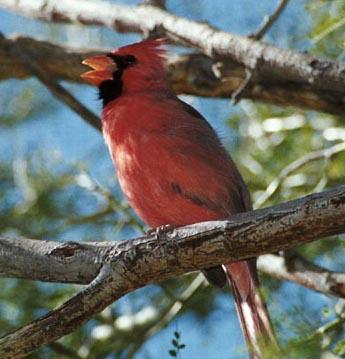
Northern cardinal singing

Northern cardinal singing

 
by Val Cunningham
Contributing Writer

Bird songs are designed to attract a mate or repel a rival, but birds have other things they need to communicate. Pairs need to stay in contact, flocks confer back and forth and a bird that notices a potential attacker will issue a warning. For these and other purposes birds rely on calls—a repertoire of short, unmusical sounds that convey specific information. Unlike a bird’s song, much of which is learned, bird calls are instinctual, an innate means of communicating.

Calls may be loud, such as the crow’s “caw, caw” or might be very soft, like the “tssp” sound used by a hiding robin to warn others that danger is nearby.

Chickadees call “chick-a-dee-dee,” to sound an alarm, call to the flock and warn off low-ranking birds (their song is a soft, whistled “fee-bee-bee”). When a chickadee gives a high-pitched “see-see” sound it’s warning of clear and present danger, such as the presence of a bird-eating hawk.

Cardinals have 10 or more distinct calls, with the most familiar being a loud, metallic “chip.” Cardinals get a lot of use out of that sound: late in the day it may signal that the caller is heading to his night roost. Mid-day it might mean danger is around, while in nesting season it may mean one parent is approaching the nest. Sometimes it’s a contact note between a cardinal pair. There must be nuances in the sound that bird ears pick up.

Blue jays are noisy, aggressive birds with a variety of sounds for various purposes. That familiar, loud “jeer” may announce that a blue jay is coming in to feed, or is intended to frighten smaller birds away from feeders to allow the jay easy access. Jays are excellent parents, intolerant of any threat to their brood, and make ear-splitting raucous calls to drive intruders away.

Their cousins, the crows, have more than 20 different calls. One of the most interesting is the rattle call, sounding like castanets, given when a crow is excited. There’s the familiar multi-purpose “caw,” plus a sort of “ack-ack” sound and crows sometimes click their beaks. Crows at their nighttime roosts make an astonishing amount of noise as they gossip with their neighbors long past nightfall.

Mourning dove wings make a loud whistle when the birds take off or land quickly, a sound that seems designed to startle an intruder or warn flock mates of danger.

Goldfinches are noisy little birds that, like all flocking birds, chatter a great deal to stay in touch with each other. A single goldfinch flying overhead while calling “per-chick-o-ree” is staying in touch with his or her flock. These birds often choose to gather together to feed and their high-pitched “see-seeEEd” call may be issuing a dinner invitation.

Downy woodpeckers aren’t songbirds, but can convey a wide range of messages with a variety of short calls. A loud “teak” note is usually used by one member of a pair to stay in contact with the other. A descending whinny can be used as a contact call or to signal aggression.

Songbirds and woodpeckers are great communicators and since they aren’t solitary there’s a great deal to communicate with other birds. Keep an ear out for some fascinating “tweets” from the bird world.

St. Paul, Minnesota resident Val Cunningham, leads bird hikes for the St. Paul Audubon Society and writes about nature for local, regional and national newspapers and magazines.

Bird Spotlight

  • Red-Bellied WoodpeckerJanuary 29, 2014 - 5:42 pm
  • 8 Ways to Help BirdsDecember 29, 2013 - 5:20 pm
  • The Squeaky Bird of the ForestNovember 16, 2013 - 7:20 pm
  • Bird World Changes With the SeasonsOctober 16, 2013 - 7:48 pm
  • A River of Birds Stream by at NightSeptember 16, 2013 - 8:19 pm
  • Male Rose-breasted Grosbeak
    Grosbeaks are the Bandana BirdJuly 19, 2013 - 7:26 pm
  • Indigo Bunting
    Blue Indigos Catch the Eye — and EarJuly 19, 2013 - 7:12 pm
  • Very young red-tailed hawks
    Nest Cams Put You in the Catbird SeatJune 19, 2013 - 7:40 pm
  • Great-horned Owl
    It’s Hooting Season for Great-Horned OwlsFebruary 19, 2013 - 7:48 pm
  • male Pine Grosbeak
    Watch for Handsome, Hungry Winter FinchesJanuary 19, 2013 - 8:02 pm
  • White-breasted Nuthatch
    Birds Triumph Over the ColdDecember 20, 2012 - 6:47 pm
  • Downy Woodpecker at suet feeder
    Downies, the Pocket-Sized WoodpeckersNovember 20, 2012 - 6:54 pm
  • Scarlet Tanager
    Birds Eating WeirdlyOctober 20, 2012 - 7:22 pm
  • Sandhill Crane
    Cranes families are on the moveSeptember 20, 2012 - 7:35 pm
  • Pair of prothonotary warblers
    Songs subside as birds rear their youngJuly 20, 2012 - 7:45 pm
  • Blue Jays hash it out at feeder
    Blue Jays Get a Bad RapJune 21, 2012 - 3:25 pm
  • Tree Swallow nest
    The Incredible EggJune 21, 2012 - 3:21 pm
  • Male goldfinch feeds young
    Nature’s TurncoatsMay 21, 2012 - 3:32 pm
  • great horned owl
    Night’s silent hunters may live in your ‘hoodApril 21, 2012 - 4:07 pm
  • White-throated Sparrow
    Beautiful Springtime MusicApril 21, 2012 - 3:45 pm

Saint Paul Bird Alliance
P.O. Box 7275
St. Paul, MN 55107

Saint Paul Bird Alliance is a chapter of the National Audubon Society, Inc.

Donate to Saint Paul Bird Alliance >

Subscribe to The Cardinal newsletter >

Upcoming Events >

Contact Saint Paul Bird Alliance >

© Copyright - Saint Paul Bird Alliance 1945 - 2024. All Rights Reserved. | Powered by simpleDesigns
  • Link to Facebook
  • Link to X
  • Link to Youtube
Link to: Spring is Robin Season Link to: Spring is Robin Season Spring is Robin SeasonAmerican Robin Link to: Avian Architects Link to: Avian Architects American RobinAvian Architects
Scroll to top Scroll to top Scroll to top