
• Link to Facebook
  • Link to X
  • Link to Youtube
Saint Paul Bird Alliance
  • About
    • Who We Are
    • Chapter Leadership
    • Annual Reports
      • 2024-2025 Annual Report
      • 2023-2024 Annual Report
      • 2022-2023 Annual Report
      • 2021-2022 Annual Report
      • 2020-2021 Annual Report
      • 2019-2020 Annual Report
    • Finances
      • 2022-23 Financial Summary
      • 2023-2024 Financial Summary
      • 2025 – 2026 Budget
    • Board Minutes
      • Board Minutes 2024
        • Jan. 2024 Board Minutes
        • Feb. 2024 Board Minutes
        • March 2024 Board Minutes
        • April 2024 Board Minutes
        • May 2024 Board Minutes
        • Sept. 2024 Board Minutes
        • Oct. 2024 Board Minutes
        • Nov. 2024 – Board Minutes
        • Dec. 2024 Board Minutes
      • Board Minutes 2025
        • Jan. 2025 Board Minutes
        • Feb. 2025 Board Minutes
        • March 2025 Board Minutes
        • April 2025 Board Minutes
        • May 2025 Board Minutes
        • May 2025 Annual Meeting and Election Board Minutes
        • Sept. 2025 Board Minutes
        • Oct. 2025 Board Minutes
        • Nov. 2025 Board Minutes
        • Dec. 2025 Board Minutes
      • Board Minutes 2026
        • Jan. 2026 Board Minutes
        • Feb. 2026 Board Minutes
        • March 2026 Board Minutes
        • April 2026 Board Minutes
  • Events
  • Get Involved
    • Volunteer
    • St. Paul Bird Alliance Membership
    • Join National Audubon
  • Grants
    • Applying For A Grant
    • Grants in Action
  • Conservation Action
    • American Kestrel Nest Box Monitoring
    • Battle Creek Properties at Risk
  • News
    • News Blog
    • Archive: Newsletter
    • Subscribe
  • Contact Us
  • Click to open the search input field Click to open the search input field Search
  • Menu Menu

Avian Architects

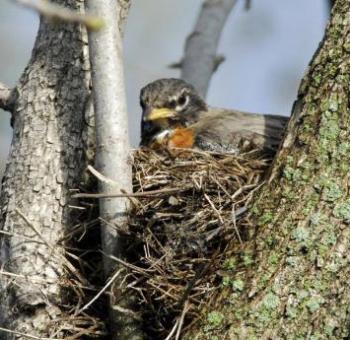
American Robin

American Robin
Photo credit: Jim Williams

 
by Val Cunningham
Contributing Writer

Raise the family in a birdhouse or on a branch? Birds have their own ideas about what’s best for their broods.

Some birds are forced to play a variation of the musical chairs game as nesting season approaches. Their hormones tell them it’s time to start raising a family but for cavity nesters, there simply isn’t enough housing to go around.

These “inside nesters” include bluebirds, tree swallows, wood ducks, chickadees and house wrens, who scramble to find an enclosed space to hold their eggs. The winners take over tree cavities hollowed out by woodpeckers or formed by a fallen branch. Since these are short supply, kind-hearted humans help by setting out nest boxes for their backyard birds.

Even though this annual housing scramble is the reality for only a minority, many of us tend to think that all birds raise their young in birdhouses. In fact, only about 10 percent of the birds that nest in our state do. Most build their nests in the great outdoors, on a twig or branch in wetland, forest or backyard. Every bird grows up knowing exactly what kind of nest his or her species builds and where to place it because this information is hard-wired into their brains. Naturalist and author Scott Weidensaul calls this birds’ “exquisite, instinctive architecture.” Birds make refinements as they gain experience over the years, but all stick to their species’s basic, time-tested template.

Set in stone

Since there’s some confusion about which birds do use birdhouses, let’s consider a few, common backyard favorites. What kind of housing do cardinals prefer? Cardinals build nests outside: you could place a marble birdbath in a birdhouse, but it still won’t attract these handsome red songbirds. How about goldfinches? As much as they love seeds, even a seed ball inside a nest box won’t do the trick—they always build outside. And what’s best for hummingbirds? Even a miniature Taj Mahal with a nectar fountain won’t divert a busy female hummingbird from building her tiny nest outside, on a twig.

These and the many other outside nesters aren’t as restricted as cavity nesters: they can build wherever they choose, as long as no other bird claims the same territory. They won’t ever nest inside, no matter if there’s a perfect tree hole or a tiny Swiss chalet available.

The American robin is an example of a bird that won’t use a birdhouse. The female chooses a likely spot on a tree limb or ledge. She carries in mud balls to form a strong foundation, then packs in grass, plant stalks, even string.

Baltimore orioles won’t be diverted from carrying in long plant stalks to weave their intricate purse nests at the tip of a tree branch. Goldfinches wait until late in the season, when thistle is going to seed, to make neat little nests lined with thistle and cattail down. Cardinals tuck their grassy nests deep inside a deciduous shrub or evergreen, often only 3- to 4-ft. off the ground (these nests must be well hidden, since their location makes them very vulnerable to predators).

Birds know what they’re doing and they’ve been doing it for eons. It’s fascinating to watch adults dashing to nest sites, either inside or outside, with building materials in their beaks. Wherever they choose to nest, all parent birds hope for the same outcome—a brood of tiny, cheeping youngsters, growing swiftly toward adulthood.

Ways to help nesting birds

  • Landscape with native plants, creating habitat and food sources.
  • Set out crushed eggshells to replenish calcium (after baking at 250 degrees for 20 minutes).
  • Keep birdbath water fresh so parent birds can bathe and drink.
  • Plant shrubs for cover and nesting sites.
  • Place nesting material (short lengths of string, yarn and insecticide-free pet fur) on fence or tree branches.
  • Keep cats indoors to confine this dangerous predator of birds.

St. Paul, Minnesota resident Val Cunningham, leads bird hikes for the St. Paul Audubon Society and writes about nature for local, regional and national newspapers and magazines.

Bird Spotlight

  • Red-Bellied WoodpeckerJanuary 29, 2014 - 5:42 pm
  • 8 Ways to Help BirdsDecember 29, 2013 - 5:20 pm
  • The Squeaky Bird of the ForestNovember 16, 2013 - 7:20 pm
  • Bird World Changes With the SeasonsOctober 16, 2013 - 7:48 pm
  • A River of Birds Stream by at NightSeptember 16, 2013 - 8:19 pm
  • Male Rose-breasted Grosbeak
    Grosbeaks are the Bandana BirdJuly 19, 2013 - 7:26 pm
  • Indigo Bunting
    Blue Indigos Catch the Eye — and EarJuly 19, 2013 - 7:12 pm
  • Very young red-tailed hawks
    Nest Cams Put You in the Catbird SeatJune 19, 2013 - 7:40 pm
  • Great-horned Owl
    It’s Hooting Season for Great-Horned OwlsFebruary 19, 2013 - 7:48 pm
  • male Pine Grosbeak
    Watch for Handsome, Hungry Winter FinchesJanuary 19, 2013 - 8:02 pm
  • White-breasted Nuthatch
    Birds Triumph Over the ColdDecember 20, 2012 - 6:47 pm
  • Downy Woodpecker at suet feeder
    Downies, the Pocket-Sized WoodpeckersNovember 20, 2012 - 6:54 pm
  • Scarlet Tanager
    Birds Eating WeirdlyOctober 20, 2012 - 7:22 pm
  • Sandhill Crane
    Cranes families are on the moveSeptember 20, 2012 - 7:35 pm
  • Pair of prothonotary warblers
    Songs subside as birds rear their youngJuly 20, 2012 - 7:45 pm
  • Blue Jays hash it out at feeder
    Blue Jays Get a Bad RapJune 21, 2012 - 3:25 pm
  • Tree Swallow nest
    The Incredible EggJune 21, 2012 - 3:21 pm
  • Male goldfinch feeds young
    Nature’s TurncoatsMay 21, 2012 - 3:32 pm
  • great horned owl
    Night’s silent hunters may live in your ‘hoodApril 21, 2012 - 4:07 pm
  • White-throated Sparrow
    Beautiful Springtime MusicApril 21, 2012 - 3:45 pm

Saint Paul Bird Alliance
P.O. Box 7275
St. Paul, MN 55107

Saint Paul Bird Alliance is a chapter of the National Audubon Society, Inc.

Donate to Saint Paul Bird Alliance >

Subscribe to The Cardinal newsletter >

Upcoming Events >

Contact Saint Paul Bird Alliance >

© Copyright - Saint Paul Bird Alliance 1945 - 2024. All Rights Reserved. | Powered by simpleDesigns
  • Link to Facebook
  • Link to X
  • Link to Youtube
Link to: Call of the Wild Link to: Call of the Wild Call of the WildNorthern cardinal singing Link to: June/July 2011 Link to: June/July 2011 June/July 2011
Scroll to top Scroll to top Scroll to top