
• Link to Facebook
  • Link to X
  • Link to Youtube
Saint Paul Bird Alliance
  • About
    • Who We Are
    • Chapter Leadership
    • Annual Reports
      • 2024-2025 Annual Report
      • 2023-2024 Annual Report
      • 2022-2023 Annual Report
      • 2021-2022 Annual Report
      • 2020-2021 Annual Report
      • 2019-2020 Annual Report
    • Finances
      • 2022-23 Financial Summary
      • 2023-2024 Financial Summary
      • 2025 – 2026 Budget
    • Board Minutes
      • Board Minutes 2024
        • Jan. 2024 Board Minutes
        • Feb. 2024 Board Minutes
        • March 2024 Board Minutes
        • April 2024 Board Minutes
        • May 2024 Board Minutes
        • Sept. 2024 Board Minutes
        • Oct. 2024 Board Minutes
        • Nov. 2024 – Board Minutes
        • Dec. 2024 Board Minutes
      • Board Minutes 2025
        • Jan. 2025 Board Minutes
        • Feb. 2025 Board Minutes
        • March 2025 Board Minutes
        • April 2025 Board Minutes
        • May 2025 Board Minutes
        • May 2025 Annual Meeting and Election Board Minutes
        • Sept. 2025 Board Minutes
        • Oct. 2025 Board Minutes
        • Nov. 2025 Board Minutes
        • Dec. 2025 Board Minutes
      • Board Minutes 2026
        • Jan. 2026 Board Minutes
        • Feb. 2026 Board Minutes
        • March 2026 Board Minutes
        • April 2026 Board Minutes
  • Events
  • Get Involved
    • Volunteer
    • St. Paul Bird Alliance Membership
    • Join National Audubon
  • Grants
    • Applying For A Grant
    • Grants in Action
  • Conservation Action
    • American Kestrel Nest Box Monitoring
    • Battle Creek Properties at Risk
  • News
    • News Blog
    • Archive: Newsletter
    • Subscribe
  • Contact Us
  • Click to open the search input field Click to open the search input field Search
  • Menu Menu

“Dog days” are prime time for birds
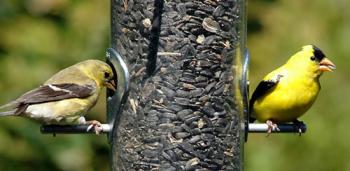
American goldfinches

American goldfinches
Photo credit: Jim Williams

 
by Val Cunningham
Contributing Writer

Late summer is a time for birds to kick back a bit and catch their breath before it’s time to start preparing for winter.

We call this time, as summer begins to wind down into autumn, the dog days of summer, but it could just as well be known as the relief season for birds. School-age kids are feeling the summer doldrums, but adult birds must be feeling a sense of release from one of the most arduous periods of their year.

Spring and summer are rigorous, exhausting seasons, with hormones driving them to select a territory and hold it against all comers, followed by the push to build a nest and fill it with nestlings. This is followed by several weeks of making thousands of trips to snare caterpillars and other insects and stuff these down small gullets. Finally, fledglings have left the nest and parental duties are abating.

Not that it’s all over: there’s still plenty of work for many adult birds, as they continue to feed their offspring outside the nest for a number of weeks. Think of the noisy aggregations of house finches, with youngsters following a parent around and loudly demanding a feeding. Young robins are still making that “chirrup” sound as they perch on branches and expect Mom or Dad to show up with a tasty treat. Young warblers, bluebirds, vireos and swallows are still a few weeks away from being told to hit the road, figuratively.

But now there’s more free time each day for adult birds, time they can use to bathe, rest and begin molting new feathers for autumn. Many songbird diets undergo a change at this time, which frees up even more time. Instead of chasing after insects, creatures that fly, hop or run away from birds trying to feed their offspring and themselves, in late summer adults return to bird feeders and bring their offspring in to try what for them is a new diet.

In addition, ripe seeds and fruits are becoming abundant in nature and have another positive attribute: they hold still as birds settle in to feast (unlike wiggling insects).

Some birds are starting to gather in big flocks in open areas, especially blackbirds, purple martins, cowbirds and swallows. For others, this is the time to stay close to home to replace feathers worn down during the hectic pace of summer. Most birds drop old feathers and grow new ones in a slow, balanced way—one from one side of the body or wing, one from the other side. A few birds, perhaps due to mites or other causes, may lose many feathers all at once, most noticeably from their heads. This kind of asynchronous molt, seen especially in cardinals and blue jays, is startling. Our familiar red or blue birds suddenly display black reptilian, featherless heads. Their head feathers inevitably grow back but the birds look like aliens for several weeks.

The post-breeding respite doesn’t last long. Any day now birds’ instincts will signal that it’s time to start the pre-migration process. They’ll begin to pack on the weight needed to fuel the start of their journeys. Families break up and birds become independent agents. Mothers and fathers begin to answer only to their own needs. This year’s fledglings have a hard-wired sense that prepares them to travel, as well.

For a couple weeks, before migration, birds are enjoying the last lushness of summer, and they’ve certainly earned it.

St. Paul, Minnesota resident Val Cunningham, leads bird hikes for the St. Paul Audubon Society and writes about nature for local, regional and national newspapers and magazines.

Bird Spotlight

  • Red-Bellied WoodpeckerJanuary 29, 2014 - 5:42 pm
  • 8 Ways to Help BirdsDecember 29, 2013 - 5:20 pm
  • The Squeaky Bird of the ForestNovember 16, 2013 - 7:20 pm
  • Bird World Changes With the SeasonsOctober 16, 2013 - 7:48 pm
  • A River of Birds Stream by at NightSeptember 16, 2013 - 8:19 pm
  • Male Rose-breasted Grosbeak
    Grosbeaks are the Bandana BirdJuly 19, 2013 - 7:26 pm
  • Indigo Bunting
    Blue Indigos Catch the Eye — and EarJuly 19, 2013 - 7:12 pm
  • Very young red-tailed hawks
    Nest Cams Put You in the Catbird SeatJune 19, 2013 - 7:40 pm
  • Great-horned Owl
    It’s Hooting Season for Great-Horned OwlsFebruary 19, 2013 - 7:48 pm
  • male Pine Grosbeak
    Watch for Handsome, Hungry Winter FinchesJanuary 19, 2013 - 8:02 pm
  • White-breasted Nuthatch
    Birds Triumph Over the ColdDecember 20, 2012 - 6:47 pm
  • Downy Woodpecker at suet feeder
    Downies, the Pocket-Sized WoodpeckersNovember 20, 2012 - 6:54 pm
  • Scarlet Tanager
    Birds Eating WeirdlyOctober 20, 2012 - 7:22 pm
  • Sandhill Crane
    Cranes families are on the moveSeptember 20, 2012 - 7:35 pm
  • Pair of prothonotary warblers
    Songs subside as birds rear their youngJuly 20, 2012 - 7:45 pm
  • Blue Jays hash it out at feeder
    Blue Jays Get a Bad RapJune 21, 2012 - 3:25 pm
  • Tree Swallow nest
    The Incredible EggJune 21, 2012 - 3:21 pm
  • Male goldfinch feeds young
    Nature’s TurncoatsMay 21, 2012 - 3:32 pm
  • great horned owl
    Night’s silent hunters may live in your ‘hoodApril 21, 2012 - 4:07 pm
  • White-throated Sparrow
    Beautiful Springtime MusicApril 21, 2012 - 3:45 pm

Saint Paul Bird Alliance
P.O. Box 7275
St. Paul, MN 55107

Saint Paul Bird Alliance is a chapter of the National Audubon Society, Inc.

Donate to Saint Paul Bird Alliance >

Subscribe to The Cardinal newsletter >

Upcoming Events >

Contact Saint Paul Bird Alliance >

© Copyright - Saint Paul Bird Alliance 1945 - 2024. All Rights Reserved. | Powered by simpleDesigns
  • Link to Facebook
  • Link to X
  • Link to Youtube
Link to: August/September 2011 Link to: August/September 2011 August/September 2011 Link to: The Miracle Called Migration Link to: The Miracle Called Migration Brown thrasherThe Miracle Called Migration
Scroll to top Scroll to top Scroll to top