
The Miracle Called Migration
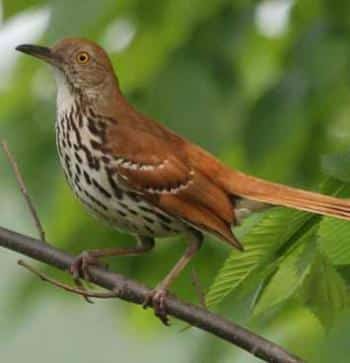
Brown thrasher
Photo credit: Don Severson
by Val Cunningham
Contributing Writer
Most of our summertime birds will soon be gone, winging their way southward in an awe-inspiring annual ritual.
Birds are starting the countdown for the big annual shift from northern regions to their winter homes. Some, like purple martins, will head deep into South America, while bald eagles will stack up at open water, which may be as close as Wabasha, Minnesota.
Baltimore orioles are gearing up to go, as are warblers and white-throated and other sparrows, marshes are emptying of red-winged blackbirds and grasslands of sedge wrens and dickcissels. Indigo buntings, rose-breasted grosbeaks and brown thrashers won’t be seen again until spring.
The bulk of fall migration occurs between the end of August and the middle of October. Many assume birds leave to escape the coming cold, but the truth is that migrants depart because their sources of food disappear as summer winds down.
Very few insects are available for kingbirds in winter, there’s little fruit for catbirds and fish and frogs are locked beneath the ice, safe from herons and osprey. In order to keep eating, many bird species must move southward. (Some seed-eating species, like cardinals and finches, and those capable of searching out hidden insects, like woodpeckers and chickadees, stay behind.)
As the sun sets earlier each day, birds’ systems release hormones that lead them to gorge on foods that pack on fat. Other hormonal messages start the molt of a fresh new set of flight feathers for long journeys.
Solo flights
Birds become restless as their take-off time approaches. However, the timing is not entirely hard-wired: adult birds rely on experience to choose a departure night that has beneficial conditions. Each bird departs and flies on its own schedule, although it will share the skies with large aggregations of other birds.
Few birds, other than cranes and geese, fly as family groups. Amazing as it sounds, “teenaged” birds, those that hopped out of nests just weeks ago, fly alone to their species’s wintering grounds.
Juveniles are able to find their way because they have a map embedded in their brains, telling them how many days to fly southward, then how long to tack westward, and where to end up. In later years, these birds will factor in cues such as the sun and star positions, magnetic fields and landmarks such as mountain ranges and rivers to help them navigate.
Flying golf balls
Male ruby-throated hummingbirds are among the early migrators, beginning their journeys in mid-August. These tiny birds may fly thousands of miles to reach Central America, so they gorge until they’re as fat as golf balls before departing.
Swallows that skimmed over parks and golf courses all summer long left weeks ago. They’ll continually replenish their tanks by feeding on insects during their daytime flights. (Not all migrants travel at night, although most songbirds do. Night flight allows for more time to feed during the day and night’s stiller and cooler air saves energy.) Eagles and hawks fly in daylight, as well, in order to take advantage of rising columns of warm air—thermals—for the soaring flight that lessens their workload.
Fall migration can be a fairly languid affair, with many birds traveling short distances before dropping down to feed and rest, and stopping for several days between travel days. They’re not in a mad rush to get where they’re going, unlike spring migration, when birds race to be first in line for the best territories.
Spring’s migration has more colorful birds, but fall’s migration dwarfs it in sheer numbers. More birds are in the skies in autumn, their ranks swelled by the millions of young birds hatched during the summer.
Migration is a dangerous business, with many hazards (storms, loss of stopover habitat, pesticides and oil spills, to name a few) but birds intrepidly pit their tiny bodies against this gauntlet twice a year. There’s almost no other event in the natural world to rival the immensity and sheer gloriousness of bird migration.
Night calls
A major advance in studying bird migration occurred in the 1990s, when researchers began recording birds’ calls during night flight, different from daytime calls, and then using computers to sort them by species. For the first time, this gave a good picture of what kinds and how many birds were passing overhead in the dark.
Sonograms stored in the computer noted that the series of whistled “puwi” sounds were made by rose-breasted grosbeaks. A raspy “vheer” meant gray-cheeked thrushes and a long “tseedt” identified the white-throated sparrow.
St. Paul, Minnesota resident Val Cunningham, leads bird hikes for the St. Paul Audubon Society and writes about nature for local, regional and national newspapers and magazines.