
Urban Eagles
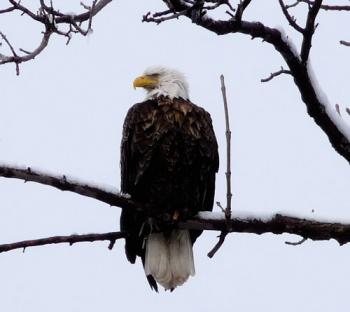
A bald eagle, one of many in the metro area, perches along Lake Como in St. Paul
Photo credit: Val Cunningham
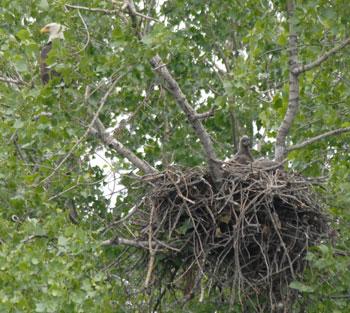
Attentive Bald Eagle near its nest and eaglet
Photo credit: Jim Williams
by Val Cunningham
Contributing Writer
Most bald eagles nest far to the north of the Twin Cities, but a number of these birds raise their young in the metro area.
Bald eagles wheel across city lakes, fly above urban freeways and perch near the top of tall trees in our parks, nature areas and riversides. These majestic birds with wings stretching an amazing 7 feet from tip to tip still cause us to stop what we’re doing and gaze in awe.
Bald eagles will never become as ubiquitous as crows, but sightings in our area are becoming a regular occurrence. These massive raptors are a symbol of the wilderness to many, and indeed most of Minnesota’s 1,300 breeding pairs of eagles raise their young in northern areas.
However, closer to home, wildlife researchers and parks staffers estimate that there are up to 90 bald eagle nests in the seven county metro area. (Not all are actively used—some bald eagles maintain multiple nests, switching between them from one year to the next.) There are few other areas in the country where urban residents are treated to such regular sightings of our national bird.
Nest trees, tall enough to offer a wide view of the surrounding countryside, are often located near a lake or river. St. Paul’s Lilydale/Harriet Island Regional Park has an active eagle nest, eagles nest along the Minnesota River in Bloomington and a number of Hennepin County parks host eagle nests. There’s a well-known eagle nest on Highway 36 in Maplewood, with thousands of cars whizzing by every day. Although these urban eagles may seem inured to the hustle and bustle of human activity, they and all of their kind still require some consideration.
“Bald eagles may be nesting near a busy road and have become used to the daily traffic,” says Margaret Rheude, a wildlife biologist with the U.S. Fish and Wildlife Service, “but that doesn’t mean they’d be tolerant of someone stopping a car and getting out to approach their nest tree.”
Such behavior could alarm an eagle, causing it to “flush,” leaving nest occupants vulnerable to predators and the elements. Everyone I talked to, from Ramsey County Parks, Three Rivers Parks, the Minnesota DNR, the Minnesota River National Wildlife Refuge and the U.S. Fish and Wildlife Service, asks that observers stay at least a quarter of a mile away from eagle nests during prime breeding season—late February to mid-April in our area. A nest may not appear to be occupied, since eagles usually hunker down and may only be visible when shifting position or being relieved of nest duty by a mate. This is where binoculars come in handy.
Huge nests
Bald eagles build big. A new nest may only be 4 feet across and a foot tall, but the nest grows as adults add more sticks each year. Older nests are quite large and are highly visible from a distance, near the top of a tree. A nest may reach 9 feet across and up to 20 feet deep, about the size of a nest in Ohio that eagles used for 34 years, until its tree eventually blew down.
It’s taken a long time to get to the point where eagles sightings are a regular occurrence. Bald eagle numbers dwindled to just over 400 nesting pairs in the contiguous United States by 1963. Decades of illegal hunting, habitat loss and exposure to the pesticide DDT had taken their toll. A whole host of government agencies, American Indian tribes, conservation organizations, private landowners and others worked to bring our national symbol back. After four decades of federal protection, eagles now nest in every state. It’s estimated that there now are 9,800 pairs across the country, with Florida and Wisconsin just behind Minnesota in number of nesting eagles.
Eagles are bounding back, but there’s still a great deal of work to be done, especially in terms of habitat protection and lead ammunition ingestion by eagles.
So as much as we all love bald eagles we must be careful to give them elbow room. Watch from a distance and the metro area will continue to provide awe-inspiring sights of eagles soaring overhead and perching alongside urban waterways.
St. Paul, Minnesota resident Val Cunningham, leads bird hikes for the St. Paul Audubon Society and writes about nature for local, regional and national newspapers and magazines.